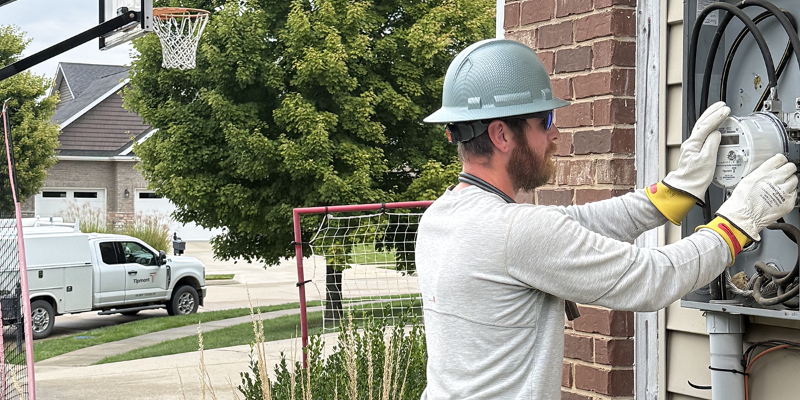
Tipmont’s advanced metering upgrade is giving the Indiana cooperative greater visibility into its distribution system and putting near-real-time energy information in members’ hands. Together, the new meters and optional Sense technology could help Tipmont improve reliability, strengthen outage response and give members information they can use to manage electricity consumption.
Tipmont is replacing a 15-year-old power-line-carrier system with Landis+Gyr Revelo meters and a radio-frequency network. The approximately 32,000-meter deployment spans eight counties and supports outage detection, power-quality monitoring and expanded data collection at the grid edge.
“It’s going to help us improve reliability, respond to outages faster and provide members with better energy information,” said Jeremy Konkle, Tipmont’s chief operating officer.
It’s going to help us improve reliability, respond to outages faster and provide members with better energy information.

The meters’ computing capability is changing what Tipmont can expect from the technology. Previously, the cooperative often learned about an outage only after a member called. The new meters can send a “last gasp” notification when they lose power, helping operations personnel identify outages and improve member communications. They also provide hot-socket detection and more detailed operational data.
The meters communicate over a radio-frequency network to gateways connected to Tipmont’s fiber infrastructure. In the future, the network could support distribution equipment such as reclosers and fault indicators, extending visibility farther across the system.
“We know what’s happening at the substation because we have fiber there, but we were very blind to all the infrastructure that’s beyond the substation,” Konkle said.
The project also extends benefits to members.
The new meters include computing capability that supports Sense technology for members who opt in. Participating members can use the Sense app to visualize household electricity use and gain insight into individual loads without installing the separate in-home monitoring equipment traditionally required.
Sense uses machine learning to analyze electrical patterns created by appliances and other devices. As the technology learns those signatures, it can help participating members identify where electricity is being used, translating high-resolution data into practical information.
That distinction matters because more data does not necessarily mean better information. Tipmont had already seen the value of Sense during home energy assessments, where visualizations made complex energy concepts easier to understand.
“In 30 seconds, somebody can process that and know what you’re talking about,” Konkle said. “They might say, ‘I had no idea my dehumidifier used this much energy.’”
Helping members understand when they use electricity could become increasingly valuable as wholesale power market conditions change.
Konkle said Tipmont is seeing high-price periods shift later into the evening. Demand-management efforts have traditionally focused on late-afternoon peaks, when solar generation can help meet demand. After sunset, solar production falls while electricity use remains high.
For Tipmont, that shift can move the most expensive energy prices past sunset. Konkle said wholesale energy that costs about $30 per megawatt-hour during much of the day can spike to $1,000 per megawatt-hour for short periods in the evening.
“Where MISO is really having capacity constraints is when the sun goes down those first couple hours and people are still using electricity,” he said.
That volatility adds another potential benefit to advanced metering. Tipmont currently offers residential time-of-use rates on an opt-in basis. The new infrastructure gives the cooperative more flexibility to expand rate options or develop demand-management programs as market conditions change.
Sense could provide the member-facing component. If members understand which household loads are operating and when, future programs could help them shift discretionary electricity use away from expensive periods. Members could make informed choices while Tipmont gains another potential tool to manage wholesale power costs.
Together, the technologies connect grid intelligence with member engagement. The meters help Tipmont understand conditions across its distribution system, while Sense helps participating members understand electricity use inside their homes.
For Konkle, awareness is only the first step. The question that turns information into value is simple: “What action can you take?”