Co-op News
May 4, 2026
Co-ops Can’t Bridge the Digital Divide Without Workers

In a moment when headlines are dominated by artificial intelligence, data centers and the escalating demand for high-capacity computing, a quieter but more urgent reality is taking shape in rural America: ensuring communities have the skilled workforce needed to support expanding broadband infrastructure.
Electric cooperatives—longtime providers of essential infrastructure in rural areas—are increasingly stepping into broadband delivery as part of their mission to serve members where the market has historically fallen short. Many cooperatives have secured financing or other funding and are prepared to build, but the availability of skilled labor is emerging as a limiting factor in how quickly and effectively projects can move forward.
The broadband construction and operations sector relies on a diverse mix of skilled workers, including fiber and wireless technicians, network architects, field engineers and
electricians. Yet, the labor pool for these occupations has been shrinking for more than two decades. Much of the industry’s growth occurred in the 1990s, and today one in five workers is over age 55, signaling a surge in retirement at the same moment demand is accelerating.
By 2032, a recent Pew Research Center study predicts the industry will need to fill 28,000 broadband construction jobs and 30,000 technician roles, while also replacing 120,000 retiring or departing workers. This widening gap threatens to become one of the most significant bottlenecks in rural broadband deployment.
Telecommunications Workforce in Decline Following 2001 Peak
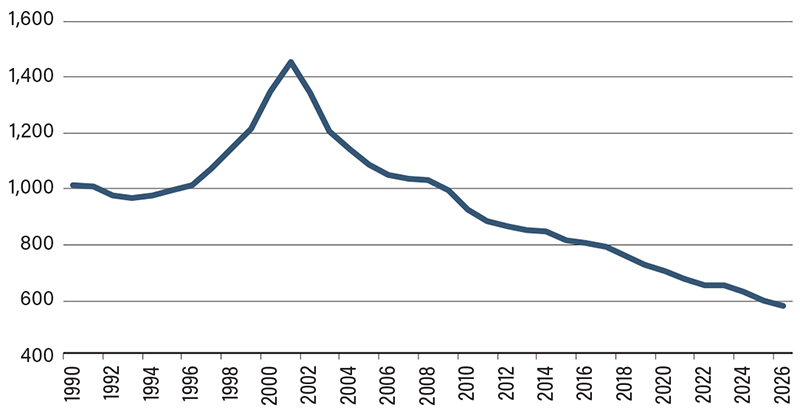
SOURCE: U.S. BUREAU OF LABOR STATISTICS.
Recent federal investment in broadband infrastructure is expected to accelerate deployment nationwide, increasing both opportunity and complexity for rural providers. While access to capital may no longer be the primary barrier in many regions, workforce readiness remains a critical variable.
Without strategic planning, electric cooperatives and their subsidiaries risk delays, cost overruns and challenges sustaining systems over time. As projects scale, workforce considerations must extend beyond construction to include ongoing operations, maintenance and system upgrades.
Cooperatives enter broadband efforts with a strong foundation of member trust. In an NRECA survey, 60% of electric cooperative consumers identified their local cooperative as their most trusted broadband partner. That trust brings an added responsibility to deliver reliable service while maintaining the long‑term financial and operational health of the organization.
To meet these expectations, many electric cooperatives are taking proactive steps to address workforce needs, including:
- Forecasting workforce requirements early, aligning staffing plans with buildout schedules and long‑term operational demands.
- Developing local talent pipelines by partnering with high schools, vocational schools, workforce boards and technical colleges to support training and apprenticeships.
- Strengthening contractor and vendor relationships to ensure labor availability and reduce project bottlenecks.
- Leveraging regional partnerships with statewide associations and neighboring cooperatives to share resources and expand access to skilled labor.
Across the country, training programs and certification efforts are helping prepare new workers for broadband-related roles. Industry organizations and applied technology institutions are expanding hands‑on training opportunities that align with real‑world infrastructure needs. In Tennessee, for example, the Tennessee College of Applied Technology provides students with practical instruction and certifications designed to support workforce entry.
For electric cooperatives, investing in workforce development is not only about completing projects, but also about sustaining service and strengthening the communities they serve. As broadband expands, the ability to recruit, train and retain skilled workers will play a central role in determining long‑term success.
Continuing to bridge the digital divide will require capital, technology and careful planning, but ultimately it depends on people.