energy-tech
May 4, 2026
SECO Energy Pilots AI Translation To Improve Member Service
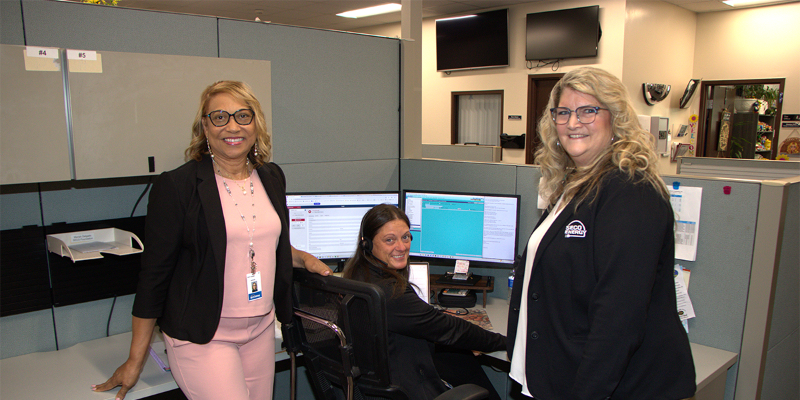
(L to R) SECO Vice President of Communications, Community and Member Experience Kathy Judkins, SECO Member Support Agent Glenda Hagelston and SECO Director of Member Services Donna Etts.
As electric cooperatives serve increasingly diverse communities, language barriers in member services are becoming a more visible operational challenge. SECO Energy, which provides electric service to more than 250,000 members across seven Central Florida counties (Citrus, Hernando, Lake, Levy, Marion, Pasco and Sumter), is piloting an artificial intelligence (AI)-based translation tool designed to support near-real‑time communication between member service agents and non‑English‑speaking members.
SECO is the third‑largest electric cooperative in Florida and the seventh largest in the nation, serving a rapidly growing and increasingly multilingual population. To address this reality, SECO is testing an AI-enabled call transcription and translation tool that allows agents to communicate with members in their native language without relying on third‑party interpreters. Census data suggest that language diversity is a growing reality across SECO’s service area, with an estimated 6%–18% of residents speaking a language other than English at home, most commonly Spanish, followed by Portuguese and Haitian Creole.
“We’ve struggled with language translation for years,” SECO Director of Member Services Donna Etts said. “We looked at third‑party interpreter services, but the cost was extremely high. Some were quoting rates starting at $0.45 per minute, and certain languages would cost even more.”
Instead, SECO began piloting an AI translation tool that integrates directly into its existing call center software. With a single click, agents can activate near-real‑time translation that converts a member’s spoken language into English audio and text while simultaneously translating the agent’s response back into the member’s language.
“It writes it out as well as translates almost in real time,” Etts said. “If you miss what they’re saying, you can also read it. That’s been a big advantage for our agents.”
It writes it out as well as translates almost in real time. If you miss what they’re saying, you can also read it. That’s been a big advantage for our agents.
Importantly, SECO leadership emphasized that the tool is designed to support employees, not replace them.
“We are not looking at AI to replace employees,” SECO Vice President of Communications, Community and Member Experience Kathy Judkins said. “Our strategy is enablement. We’re trying to improve the effectiveness of our employees by equipping them with better tools to enhance service—not replace the human connection that defines how we serve members.”
We are not looking at AI to replace employees. Our strategy is enablement.
Early testing suggests the tool can handle a wide range of call types, including billing, outages and account questions. While SECO has not yet encountered major limitations, staff noted that electric industry terminology may require additional customization.
“If there’s a certain word, you can actually go in and tell the system what that word means,” Etts said.
SECO is also taking a cautious approach to governance. The cooperative has already adopted an organizational AI use policy and is actively expanding its framework to include data governance and intellectual property protections.
“We’re working on an intellectual property policy and a data governance policy to bring everything together,” SECO Vice President of Corporate Strategy, Innovation & Technology Tolu Omotoso said. “Any AI system we integrate has to protect our data. We don’t want AI tools pulling our information and sending it somewhere we can’t control.”
Any AI system we integrate has to protect our data. We don’t want AI tools pulling our information and sending it somewhere we can’t control.

Security and privacy remain central considerations. SECO does not accept credit card payments over the phone, and call recordings and data are secured and retained only for a limited time.
The pilot is still in its early stages, with broader rollout expected after initial testing. Success metrics are still being developed, but leaders anticipate improvements in first‑call resolution and member satisfaction.
“At the end of the day, members want to be understood,” Etts said. “If we can communicate clearly in the moment, that alone is a win.”