- Main
-
As an economist, I often get asked whether the U.S. dollar will be replaced as the world’s dominant currency. My answer starts with a contractor’s rule: good, fast, cheap—pick two. International finance has its own version: a fixed exchange rate, free capital flows and independent monetary policy. Pick two. Economists call this the “impossible trinity,” and it helps explain why replacing the dollar is harder than announcing plans to use something else.
The U.S. allows the dollar’s exchange rate to fluctuate, preserving open capital markets and the Federal Reserve’s ability to set interest rates for domestic conditions. China manages the yuan’s exchange rate and restricts capital movements, retaining greater control over domestic financial conditions. Those restrictions, however, complicate its currency’s international ambitions. For global investors, receiving a currency is only the beginning. They also need confidence that they can invest it, sell assets and move their money when necessary. China’s capital controls help protect domestic stability but limit that freedom. Building a global currency therefore presents Beijing with an uncomfortable choice: Wider international acceptance could require surrendering some control.
The impossible trinity does not determine which currency dominates. It explains one obstacle. The dollar also benefits from deep financial markets, a vast supply of Treasury securities and established use across international borrowing, payments and reserves. These relationships reinforce one another: Businesses have reasons to use the currency their lenders, suppliers and customers already use.
Russia’s experience illustrates another barrier. According to Bloomberg, the yuan’s share of payments for Russian exports fell to 22%, roughly half its mid-2024 peak, as Chinese banks retreated under pressure from U.S. secondary sanctions. Switching currencies had not secured dependable banking access. Authorities can apply the relevant U.S. sanctions to transactions in any currency. Countries can reduce dollar use without creating an alternative system offering comparable liquidity, investment opportunities and reliable settlement. Replacing the dollar requires both the infrastructure users need and the freedom to use it.
America must still preserve confidence in its institutions and economic management. Dominance is an advantage, not a lifetime appointment. So, will the dollar be replaced anytime soon? My answer is no—but ask me again in a few years.
economy
November 16, 2026
Replacing the Dollar Requires More Than a New Currency

World Official Currency Reserves
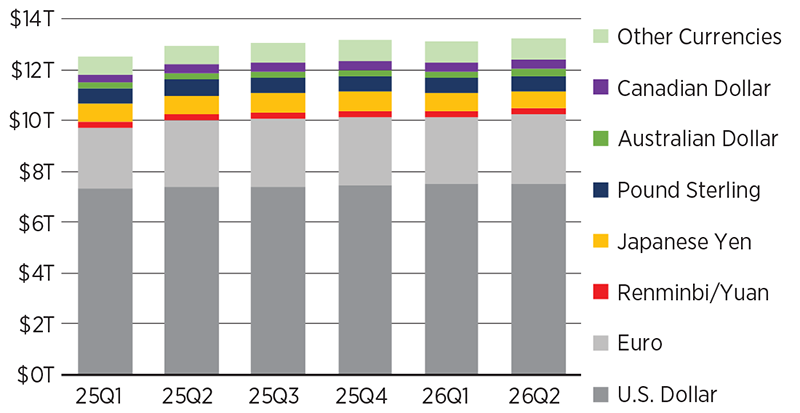
SOURCE: International Monetary Fund.