energy-tech
March 22, 2021
Battery Storage Helps Co-op Cut Costs, Improve Reliability
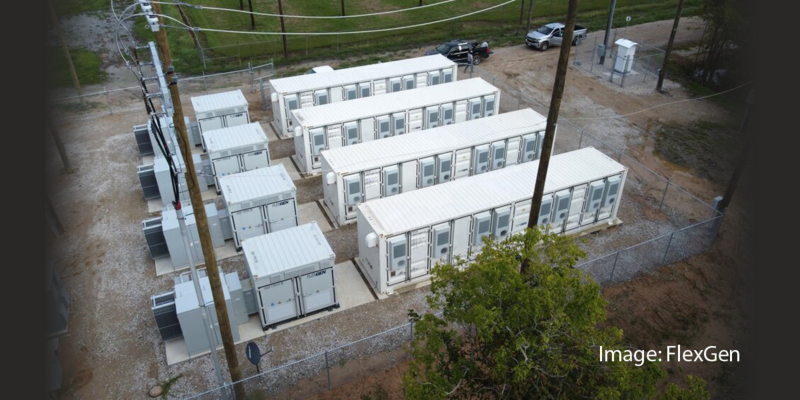
There has been a recent surge in utility-scale battery energy storage projects and one company catching the wave is Columbia City, Indiana-based Northeastern Rural Electric Membership Cooperative (NREMC).
In December, NREMC announced a 108-megawatt-hour (MWh) battery storage project, one of the largest in the Midwest. Once fully deployed, the system is expected to save members more than $35 million over 20 years.
NREMC originally decided to investigate battery storage to counteract increasing transmission and capacity costs. As a member of the 13-state PJM Interconnection regional transmission organization (RTO), the cooperative has seen large increases in its transmission costs in recent years.
“Our expenses related to participating in the RTO are increasing rapidly,” NREMC President and CEO Eric Jung said. “Transmission in particular has increased at an average rate of 14 percent annually over the last five years. Battery storage would allow us to self-supply a portion of this service by offsetting peak under our RTO’s rules.”
Project Goals Include Cost Reduction, Increased Price Stability and System Reliability
Goals for the project include cost reduction, increased price stability and improved system reliability.
“Primarily, this is a cost-reduction effort. Aside from cost reductions, the storage provides a fixed price for a portion of our capacity and transmission. This will provide our members with some insulation against price volatility,” Jung explained. “Secondly, this is a reliability boost. Power supply-related outages due to transmission accounted for nearly half of our outage time in recent years. This project will help alleviate some of that.”
In addition to using the battery storage to meet members’ needs, NREMC also expects to profit by releasing stored energy back to the grid during peak periods.
“This is one of the most significant factors that led us to partner with our vendor, FlexGen,” Jung said. “FlexGen offered us guaranteed performance for the life of the project, with sufficient cycling of the units to allow us to compete in the PJM regulation market. Though this was not necessary for the project to provide positive value, it adds tremendous benefits.”
Battery Technology Prepares Co-op for Renewable Future
The technology also enables the cooperative to deploy solar power, or other renewables, and tie that output into the batteries.
“Eventually we will look to incorporate renewables,” Jung said. “Our current contractual arrangement for energy makes this less appealing today. But once these issues are overcome, we will certainly explore renewables.”
NREMC is doing a phased battery installation with initial construction at two sites this year and three additional sites in 2022 or 2023. The first two battery projects are rated at 6 MW and 7 MW and are expected to be online by the end of June. Two additional 6 MW projects are planned for 2022, and another 5 MW project is planned for 2023, but may be moved forward.
The two projects being deployed this year will be able to supply emergency power to more than 3,200 homes for three hours, if necessary.
All of the projects are sized such that they can provide a minimum of three hours of output at rated capacity. Each battery is oversized for this capacity and FlexGen will add additional battery capacity every few years to maintain rated output for the 20-year guaranteed life of the project. In addition, each unit rated less than 7 MW is capable of outputting 7 MW, albeit for a shorter duration. This allows some flexibility and additional value for PJM regulation market use.
The battery technology being used is lithium iron phosphate. “This is currently the most commercially viable solution for installations with similar parameters,” Jung stated, and every vendor participating in the cooperative’s RFP quoted similar technology.
However, Jung said NREMC would be open to using other technologies in the future. “There are ongoing advancements in storage technology that in five years may be commercially viable, such as compressed gas or flow batteries. We will continue to investigate these moving forward.”
NREMC Members Will Benefit From Substantial Cost Savings
NREMC expects the overall cost savings for its members to be substantial.
“If the first two of our five planned storage projects had been in place last summer, we would have reduced power costs by nearly $2 million,” Jung explained. “Transmission costs are approximately two-thirds of the savings. At the existing cost growth rate of 14 percent, that value doubles in just under seven years.”
NREMC receives its transmission service from Indiana Michigan Power, a subsidiary of IOU American Electric Power Co.
“Our transmission provider has been investing heavily and has shown no signs of slowing its investment. Increasing interest rates may also affect the rate of increase,” Jung said.
NREMC has modeled rates and under its most wildly pessimistic scenarios, these storage projects are still net-present-value positive in less than half their 20-year expected life—even if the revenue from potentially competing in the PJM regulation market is not included.
“Capacity is a bit more of an unknown,” Jung admitted. “This market has experienced both ups and downs over the last several years.”
Strategically, this is a part of providing a diversified portfolio of power supply services to its members. These storage projects fix the transmission and capacity costs for approximately 20 percent of NREMC’s load. Most of the remaining 80 percent is still market based, though the cooperative has also begun working with several of its larger members on back-up generation and load-reduction strategies. Over time, NREMC intends to seek further opportunities to diversify its power supply sources.
NREMC Relied on CFC Services and Financing Support for Battery Storage Project
NREMC relied heavily on its CFC Compass model to evaluate the financial feasibility of the storage projects. The cooperative already had robust models for its power supply costs, so the battery storage projects fit into its existing model nicely.
“Much of the technology backbone was already a part of our near-term work plan,” Jung added. “We began working on a fiber ring last year in order to provide reliable, high-speed connectivity to our substations. We are also in the midst of upgrading our SCADA system to enable further load control capabilities, greater reliability and better data acquisition.”
The estimated cost for all five storage projects comes to just over $30 million and CFC is providing financing.
“We approached CFC early on in the process, explaining the need and seeking a supplemental loan package specifically for the storage projects. We are very pleased CFC was able to come through for us.”
For other electric cooperatives that might be interested in battery deployment, Jung has some advice.
“Don’t pick a price, pick a partner,” he said. “We had cheaper bids but when we really dug through the details, we were less certain they could deliver over the long term. Our vendor provided the transparency we needed to truly feel confident the project will be a success.”
Jung recommends cooperatives should set out goals and expectations ahead of time, but be prepared to evaluate the value of each offering. “This is far from a one-size-fits-all situation,” he added. “The variety of O&M contracts, augmentation contracts/capacity guarantees, and capital costs were staggering. Consultants can be a big help here, but in the end, the cooperative must be able to evaluate and ultimately decide which is the best option.”