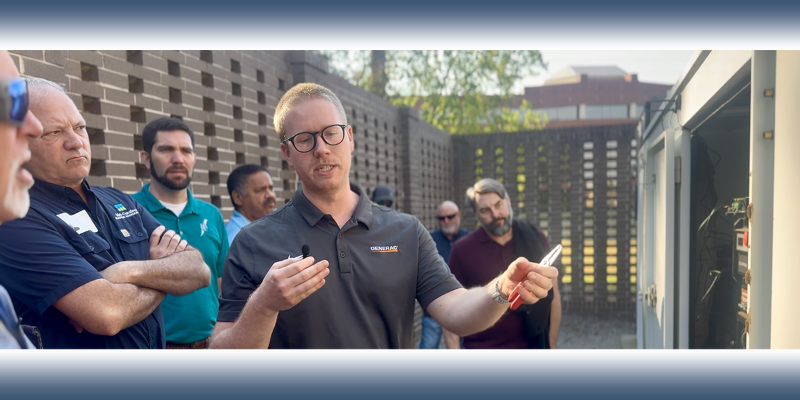
Central Electric Power Cooperative is piloting a new approach to grid resilience by tapping an often overlooked asset already sitting behind the meter: commercial backup generators. The program provides flexible capacity during pre-emergency events while giving participating businesses a way to put existing equipment to work.
Central, a generation and transmission cooperative based in Columbia, South Carolina, provides power to 19 distribution cooperatives. Central and its members serve more than 940,000 meters and over 2 million residents across 79,000 miles of power lines, reaching consumer-members in all 46 counties and more than 70% of the state’s land mass.
Scott Hammond, director of member programs at Central, said the idea emerged as the cooperative evaluated how to meet long-term resource needs.
“We have a goal of adding 25 megawatts of new distributed energy resources on the Central system as part of our diversified resource plan,” Hammond said. “As we started looking at options, our co-ops raised the idea of using existing commercial generators that are already installed at businesses.”
Rather than treating generators as a traditional demand-response or peak-shaving resource, Central’s program focuses on reliability and resilience. The generators would be dispatched only during limited pre-emergency situations, typically before outages occur.
“We’re not looking at this as economic dispatch or chasing peaks,” Hammond said. “This is about resiliency. Before we get to the point of turning off power or asking large groups of members to conserve energy, we can call on generators that would likely run anyway.”
“We have a goal of adding 25 megawatts of new distributed energy resources on the Central system as part of our diversified resource plan. As we started looking at options, our co-ops raised the idea of using existing commercial generators that are already installed at businesses.”

The pilot is open to nonresidential generators larger than 30 kilowatts. Diesel and natural gas units are expected to make up most of the fleet. Battery storage is not included at this stage.
Early implementation revealed that integration is more complex than expected.
“One thing we underestimated was the complexity of each site,” Hammond said. “Every generator installation is different—transfer switches, conduit runs, communications—all of that varies, so each location really becomes its own project.”
To address this, Central is taking a phased approach, starting with installations at cooperative facilities before expanding to member sites.
During the pilot, Central plans to install 30 to 40 control devices across a range of generator sizes. This will help Central better understand operating characteristics such as loading levels and run time performance.
“With water heaters or smart thermostats, you’re usually talking about half a kilowatt to one kilowatt per device,” Hammond said. “With generators, you can be looking at 250 or even 500 kilowatts at a single site. The magnitude is much larger.”
Participating commercial members will receive financial incentives designed to offset operating costs. The program includes a $1,000 upfront enrollment payment, per-event compensation tied to generator size and reimbursement for fuel and maintenance during test and dispatch events. Central also includes payment for participants who complete post-pilot surveys and opt out of no more than one event to help shape a potential full-scale program.
Hammond said commercial generators represent an untapped opportunity for many electric cooperatives.
“We keep hearing from our co-ops that there are a lot of unused generators out there,” he said. “If we can control them, measure them and build a program around them, it can be helpful for the co-op, beneficial for participating members and ultimately good for the entire membership.”
If the pilot proves successful, Central’s approach could offer a scalable model for cooperatives seeking to strengthen grid resilience using existing resources.