energy-tech
April 20, 2026
Missoula EC Responds to Rising Wildfire Risk
Wildfires are no longer a seasonal concern confined to the western United States. Rising temperatures, prolonged droughts, stronger wind events and increased vegetation growth have expanded wildfire risk into regions historically considered low‑threat. For electric cooperatives—many of which serve rural, heavily vegetated territories—wildfire risk now represents one of the most complex operational and safety challenges.
Unlike investor‑owned utilities, electric cooperatives often maintain thousands of miles of distribution line across forests, farmland and other hard‑to‑reach terrain. This geographic reality makes them particularly vulnerable to wildfire ignition risk, while also placing them at the center of community response and recovery efforts. As wildfire exposure grows, cooperatives are adopting proactive strategies to harden infrastructure, reduce ignition risk and improve situational awareness, all while balancing affordability for their member‑owners. One cooperative that has been navigating this shift for more than a decade is Missoula Electric Cooperative (MEC).
Montana-based MEC has spent the last decade building a structured wildfire mitigation program that blends aggressive inspection and vegetation management with operational controls, situational awareness tools and strong coordination with emergency responders. For MEC CEO Mark Hayden, the urgency became personal in 2013, when he and his family evacuated their house due to a wildfire. At the time, wildfire mitigation received far less attention, even as the cooperative wrestled with challenges like access to vegetation management on federal lands and permitting hurdles for burying lines.
Since then, the risk has only intensified: “Fire season is longer and it’s more extreme. We see it, there’s no doubt,” Hayden said, explaining why MEC chose to create a formal wildfire mitigation plan.
Fire season is longer and it’s more extreme. We see it, there’s no doubt.

MEC began developing its plan in 2020, making it an early adopter among electric cooperatives. What started as enhanced maintenance has since evolved into a structured, enterprise‑wide risk management effort that now shapes capital planning, operational protocols, employee training and member communications.
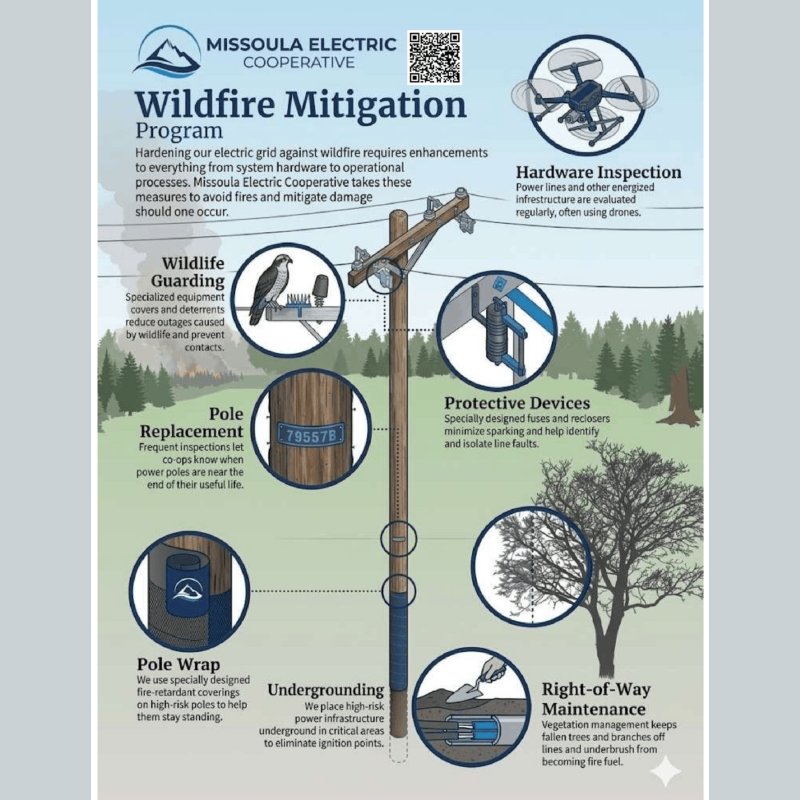
Prevention is at the core of MEC’s strategy. The cooperative has significantly increased inspection frequency, with teams inspecting roughly half of its more than 1,000 miles of overhead line each year. This aggressive cadence allows MEC to identify vegetation growth, dead and dying trees, and equipment issues before they escalate into ignition risks.
Vegetation management also extends beyond the right-of-way. Hazard trees outside cleared corridors, particularly those affected by beetle kill and drought stress, are a growing concern. By identifying and addressing these risks early, MEC reduces the likelihood that wind or weather will bring energized lines into contact with combustible material.
Rather than relying solely on large-scale infrastructure replacement, MEC emphasizes targeted system hardening. This includes covering exposed wires, connectors and equipment with wildlife protection to reduce animal contact that can spark fires. The cooperative also continues routine pole replacements and reconductoring, focusing investments where risk reduction benefits are greatest. These incremental improvements may not be highly visible, but collectively they reduce potential ignition points across the system.
One of the most critical evolutions in MEC’s approach is how it operates the grid during periods of elevated fire danger. The cooperative uses a daily situational awareness framework that considers weather conditions, wind speed, humidity and fuel status across different zones of its service territory. During high-risk periods, MEC adjusts protection settings—such as disabling or modifying automatic reclosing. While reclosing improves reliability under normal conditions, it can create sparks during a fault, increasing wildfire risk. Changing these settings can reduce ignition potential, but may result in longer outages that require manual inspection before service is restored. Integrated Services Manager Mick Aho described the goal as: “Safe operational practices, trying to avoid those public safety power shutoffs. Dialing in those settings based on the risk profile is important to the co-op and members.”
Safe operational practices, trying to avoid those public safety power shutoffs. Dialing in those settings based on the risk profile is important to the co-op and members.

MEC is also exploring predictive analytics. Through a grant, the cooperative gained access to Cloudflare’s PyreCast platform, which can generate risk profiles and model potential outcomes based on forecasted weather and fuel conditions. Balancing safety, reliability and member expectations has become a defining challenge for cooperatives operating in high‑risk environments.
Wildfire mitigation isn’t only about preventing ignitions—it’s also about coordinating a response when fires occur. Hayden said a major lesson from severe regional fire activity was the value of strong relationships with emergency services, neighboring utilities and responders. MEC participates in interagency meetings during active fire events to support consistent information sharing and safe operating decisions. The cooperative also maintains a crisis communications plan with preapproved messaging templates, enabling faster, clearer updates to members during emergencies.
Operational risk is increasingly becoming financial risk. Alongside the physical threat, MEC’s experience reflects growing pressure in the insurance market for many utilities.
“Our insurance premiums have gone through the roof,” Hayden noted. “Even securing the amount of insurance that we want and need isn’t a reality anymore.”
MEC’s experience demonstrates that wildfire mitigation is no longer optional, regional or temporary. It is a permanent operating reality shaped by climate conditions, insurance markets and community safety expectations. For cooperatives, wildfire mitigation must coexist with affordability and reliability. Hayden acknowledges that mitigation can affect rates, but argues the alternative is worse.
“We can’t afford not to make these investments,” he said, calling them, “the best investments…we’ll ever make” in community safety.
For cooperatives with limited resources, MEC’s approach also shows that progress does not require perfection. Starting with inspections, vegetation management and operational discipline can meaningfully reduce risk over time. As wildfire exposure continues to expand nationwide, the cooperative model—rooted in local knowledge, long‑term stewardship and shared responsibility—may prove to be one of the grid’s strongest assets.