energy-tech
February 17, 2026
Turning AI Into Member Value

Artificial intelligence (AI) is shifting from slide decks to operations rooms across the electric utility sector. Federal studies indicate that AI could streamline permitting, planning, reliability and outage response. For cooperatives, the near-term focus is on targeted pilots that reduce truck rolls, speed up restoration, improve member communication and strengthen governance to ensure systems remain secure and accountable.
Operations: Predict, Prevent, Respond
Some utilities have reported measurable benefits from AI-powered outage prediction, which integrates weather, SCADA, GIS and vegetation data. For example, a recent collaboration between EY and Eversource Energy prevented tens of thousands of outages over just two months of AI deployment. Vegetation management is another early success, with organizations like EPRI and the Department of Energy (DOE) highlighting data-driven inspection methods and maturity models that help programs transition to predictive analytics, reducing both outage risk and wildfire exposure.
Member Service Quiet Productivity Gains
Generative AI is already being used to summarize bills, draft outage notices, create social media posts and assist contact center staff with readymade responses—delivering practical productivity improvements.
Governance: Establishing Guardrails, Managing Risks
Expect boards to pay more attention to AI governance. The National Institute of Standards and Technology (NIST) AI Risk Management Framework (AI RMF) offers a practical structure. DOE’s 2024 “AI for Energy” report highlights both the potential benefits for reliability and planning, and the risks—such as vulnerability to data poisoning and operational errors—when AI models are deployed without sufficient oversight. Generative AI can also help write an initial draft of an AI acceptable use policy.
What Leaders Can Do Now
- Run small, time-bound pilots. Encourage staff to try generative AI and simple agents for tasks like drafting outage scripts, summarizing engineering standards or auto-routing service tickets. Measure results within specific timeframes and discontinue what does not provide value.
- Establish governance. Map use cases, assign data owners and align with the NIST AI RMF. Use the Cybersecurity & Infrastructure Security Agency’s secure deployment checklist for vendor tools.
- Share successes. Use platforms like Cooperative.com and EPRI forums to exchange prompts, agent designs and safety practices. EPRI’s Open Power AI Consortium and Cooperative.com communities support rapid learning across the network.
Over the next year, the most durable AI gains for cooperatives will come from focused, low-risk applications in outage prediction, vegetation management, AMI-enabled forecasting and member communications, all supported by simple governance and open sharing within the cooperative community.
VoltWrite: Private, Cooperative-Built AI Gains Momentum Across the Network
VoltWrite, Dairyland Power Cooperative’s private AI platform, has evolved from pilot to platform in a year, with more than 40 cooperatives now using the platform to boost productivity.
“We’re providing a private artificial intelligence solution for co-ops, by co-ops,” Dairyland Vice President and CIO Nate Melby said. “The more of us who work together, the more we can do, and we can do it safely instead of experimenting in open, public models. We have over 40 organizations on the platform right now, including distribution co-ops, statewides and G&Ts.”
Melby emphasized that while the mission is steady, the technology has advanced quickly.
“Frontier models have gotten better and reasoning capabilities have improved,” he said. “VoltWrite has advanced along with them.”
Key advances include deploying retrieval augmented generation (RAG) for participating cooperatives. RAG connects VoltWrite to a system’s trusted content so the model can access relevant policies, procedures or datasets at query time.
Dairyland is also piloting agentic AI, which uses autonomous software agents that plan tasks, access tools and data, and collaborate to complete workflows with minimal oversight. A flagship example is Atlas, an agentic AI assistant that demonstrates how multiple agents can "swarm" to solve problems.
Distribution cooperatives are using VoltWrite for high-value, day-to-day work. Common use cases include summarizing lengthy documents, accelerating workflows and anomaly analysis on operational and billing datasets.
“One co-op summarized a 600-page state law into a single page that was relevant to their needs and validated compliance,” Melby said. “Another translated a Canadian trade agreement written in French, analyzed it and compared it to their state’s law, finding an advantage.”
Dairyland even replaced a $1 million internal software application with VoltWrite-driven agents.
In the coming year, VoltWrite aims to scale up deployments across participating cooperatives, moving pilots in policy and procedure search, compliance reviews and anomaly detection into production and adding enhancements. The roadmap calls for more member-specific RAG implementations, broader use of agent-based automation beyond the Atlas showcase and reasoning capabilities with privacy guardrails. Broader participation from statewides and G&Ts is expected, supported by shared playbooks and training to standardize adoption and track measurable outcomes.
For Melby, the collaborative model is the multiplier.
“It is exciting to work with co-ops. We are learning from them as they are learning from us,” he said. “They get the right platform and privacy guardrails from day one, and we evolve VoltWrite with real use cases together.”
AI-Driven Vegetation Management at Mountain View Electric Association
In September 2024, Mountain View Electric Association (MVEA) partnered with Sheltera to modernize vegetation management across its Colorado Springs-area system. Serving over 58,000 members and covering 5,000 square miles, MVEA wanted a data-driven platform that could be incorporated into its wildfire mitigation plan.
Sheltera’s platform uses satellite imagery, LiDAR, Ortho and digital surface models to generate a heat map of problem tree clusters and provide a dashboard for job bidding and resource mobilization. A threat code system helps utilities prioritize issues, while street view images for each threat enable crews to anticipate equipment needs and deploy appropriate resources.
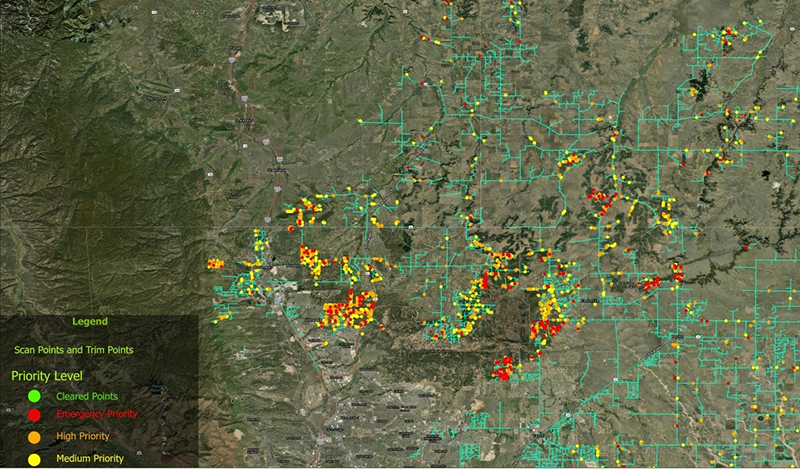 Scan before trimming.
Sheltera’s AI provides a contractor‑matching service that pairs utilities with experienced vegetation‑management providers. Once the aerial scan is analyzed and a trim schedule is developed, Sheltera identifies the contractor best suited for the required work. Through this process, MVEA was matched with Arbol Tree Service & Landscaping to perform the trimming activities. Arbol owner Efrain Aviles, Jr. reported that remote, pre-bid inspections improved bid precision and reduced project costs by roughly 40% compared with the cooperative’s previous contractor.
The collaboration addressed longstanding challenges like slow planning cycles, uneven data quality, limited contractor visibility and complex budgeting. The AI tools prioritized high-risk spans, generated span-based budgets and equipped crews with GPS-guided work orders, before and after photo capture and time-stamped documentation. The planning and budgeting process, which used to take months, was completed in just two weeks.
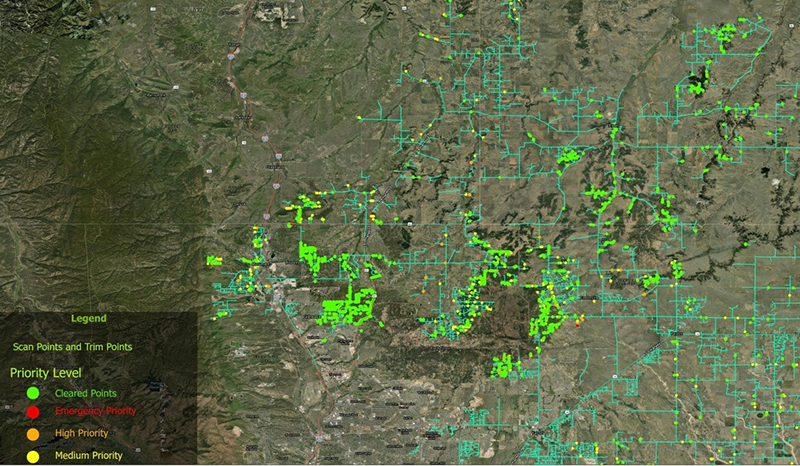 Scan after trimming.
Crews trimmed 56 miles in 136 days, down from a projected 336 days, yielding roughly 40% cost savings. Continuous monitoring further enhanced safety, reliability and resource allocation. The system identified over 1,000 hotspot areas, and dashboard data allows for ongoing updates to the wildfire mitigation plan.
Bringing AI Down to Earth: New Horizon Electric’s Model for Practical Adoption
New Horizon Electric Cooperative, led by President and CEO Bobby Smith, is seeing practical AI benefits without eliminating jobs. New Horizon owns substations and supports SCADA, cybersecurity and transmission maintenance for five South Carolina distribution cooperatives, putting it in a strong position to pilot tools that others can share.
Smith’s E3 model—expertise, efficiency and economics—guides adoption. Technicians can now query digitized transformer manuals in the field and receive precise answers in seconds instead of searching through 12-inch binders. On the member side, voice AI handles routine calls in a locally familiar voice, freeing staff to tackle complex issues and reducing onboarding time for new hires.
Boards are increasingly supportive when projects enhance service and reduce costs. Smith recommends establishing policies that govern data entry and enterprise accounts to balance security and productivity. The greatest opportunity lies in analytics: correlating decades of big data across AMI, OMS, CIS and external sources to inform decisions on reliability, staffing and load planning.
Smith’s advice to leaders is simple. Don’t overcomplicate things. Start with clear pain points, experiment with tools, collaborate and iterate. The question is not if—but how and where—to begin.
Conclusion
AI has moved from concept to practical application in electric cooperatives. The common thread in these case studies is practical gains at human scale, supported by privacy and accountability.
VoltWrite illustrates how a private, cooperative-built workbench can ground models in trusted content and evolve with real use cases. MVEA’s vegetation effort shortened planning cycles and reduced costs while supporting reliability. New Horizon’s E3 lens keeps people central and ties analytics to outcomes.
Governance frameworks such as the NIST AI RMF and secure deployment checklists are available to align innovation with each cooperative’s risk tolerance. From outage prediction and vegetation programs to AMI-enabled forecasting and member communications, there are many onramps. The right mix will depend on geography, risk profile, data maturity and member priorities.
Progress comes from open learning, clear metrics and building on what works. AI is not a single solution—it is a toolbox that cooperatives can shape to fulfill their missions.