economy
March 16, 2026
Eyes on the Economy: Export Prices, Labor Costs, Job Losses

Export Prices Rise as Import Prices Slip in January
U.S. export prices posted a year-over-year increase of 2.6% in January, easing from an upwardly revised 3.4% increase in December. Prices for agricultural exports rose 2.2% while nonagricultural export prices increased 2.7%, driven by capital goods, nonagricultural industrial supplies and materials and consumer goods. Meanwhile, January import prices slipped 0.1% from a year earlier, down from flat growth in December. The decline was largely driven by a 13.4% fall in fuel import prices, where a drop in petroleum import prices more than offset higher prices for natural gas. Prices increased 1.2% for all nonfuel imports.
Productivity and Labor Costs Rise
Nonfarm business sector labor productivity increased 2.8% in the fourth quarter of 2025 as output increased 2.6% and hours worked declined 0.2%. On a year-over-year basis, productivity was also up 2.8% from the fourth quarter of 2024, while annual average productivity increased 2.2% from 2024 to 2025.
Unit labor costs climbed 2.8% in the fourth quarter, driven by a 5.7% increase in hourly compensation and partially offset by the gain in productivity. Over the past four quarters, unit labor costs rose 1.3%. Real hourly compensation, which adjusts for inflation, increased 3.1% in the fourth quarter and 1.3% over the year. Meanwhile, labor’s share of output fell to 53.8%, the lowest level recorded since measurement began in 1947.
Since the current business cycle began in the fourth quarter of 2019, overall productivity has grown 2.2% annually—in line with the long-term historical average. However, manufacturing productivity fell 1.9% in the last quarter of 2025 as output declined, while unit labor costs surged to the largest jump since 2022—driven by higher compensation and weaker productivity.
US Economy Loses Jobs in February
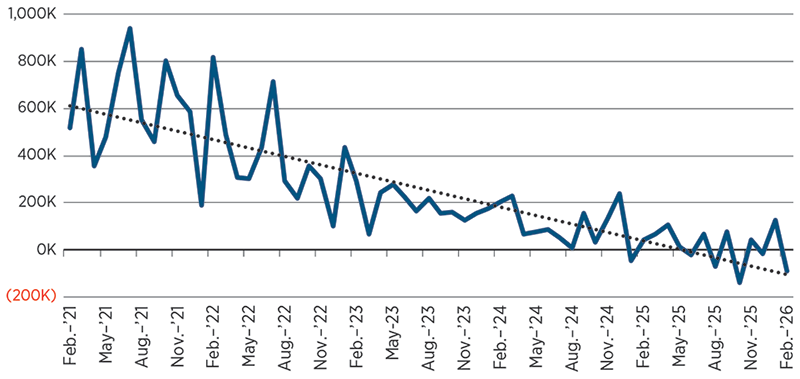
The U.S. economy lost 92,000 jobs in February. The unemployment rate edged up to 4.4% in February from 4.3% in January. While the increase in unemployment was modest, February’s release was also accompanied by downward revisions of the previous 13 months, four of which posted job losses.
In February, health care employment lost 28,000 jobs, reversing part of January’s outsized 77,000 gain. Offices of physicians shed 37,000 jobs, largely reflecting strike activity, while hospitals added 12,000. Even with February’s drop, health care has remained a consistent source of growth, averaging 36,000 new jobs per month over the past year.
Information employment continued its downward trend, declining by 11,000 in February after averaging monthly losses of 5,000 over the prior year. Federal government payrolls also fell by 10,000 and are now down 330,000, or 11%, from their October 2024 peak.
Social assistance added 9,000 jobs, led by individual and family services. Transportation and warehousing declined slightly, as losses in couriers were partly offset by gains in air transportation. Overall, the jobs report and the revisions point to a clearly weakening labor market.
Nonfarm Payrolls on a Downward Trend
Source: U.S. Bureau of Labor Statistics.