economy
April 6, 2026
Eyes on the Economy: Confidence, Sentiment, Job Openings

Consumer Confidence Edges Up Despite Surging Costs
The Conference Board Consumer Confidence Index rose slightly to 91.8 in March, up from 91.0 in February. Gains were driven by improved views of current conditions, with the subindex for the present situation climbing 4.6 points. In contrast, the expectations subindex—reflecting consumers’ outlook for income, business and labor market conditions—fell 1.7 points, remaining at a level historically associated with recession risk. Although the headline increase suggests some resilience, underlying details point to continued pressure from rising costs, particularly due to tariff pass-through and higher oil prices, which are showing up in inflation expectations.
Consumers reported improved perceptions of current business conditions. Labor market sentiment also improved slightly. However, confidence in the future weakened, with expectations for income and labor market conditions declining. Although Gen Z remained most optimistic, their confidence slipped in March. Similarly, confidence declined across most generations, with Millennials being the only group reporting an improvement.
Consumer Sentiment at Lowest Since December
In a separate survey, the Consumer Sentiment Index fell to 53.3 in March, its lowest level since December 2025, with declines across age and political groups. Middle- and higher-income households saw the sharpest drops, reflecting rising gas prices and market volatility tied to the Iran war. Short-term expectations weakened notably, with the economic outlook down 14% and expected personal finances falling 10%, while long-term views were more stable. Year-ahead inflation expectations rose to 3.8%, the largest monthly increase since April 2025, while long-run expectations edged down to 3.2%. Notably, responses collected after late February showed higher inflation concerns, suggesting recent geopolitical developments are beginning to influence consumer views.
The University of Michigan Consumer Sentiment Index can diverge from the Conference Board Consumer Confidence Index because they emphasize different factors. Sentiment centers on personal finances and inflation—“How am I doing?”—while confidence focuses on labor market and business conditions—“How do I think the overall economy is doing?”
Job Openings Fall in February as Hiring Slows
U.S. job openings declined by 358,000 to 6.88 million in February 2026, coming in slightly below expectations of 6.92 million. The drop was concentrated in accommodation and food services (down 211,000) and mining and logging (down 12,000), with declines seen across multiple regions: the Northeast, South, Midwest and West. Hiring also slowed to 4.8 million, while total separations held steady at 5 million. The quits rate edged down to 1.9%, signaling workers are less willing to leave jobs amid growing uncertainty.
Overall, the latest data suggest employers are becoming more cautious following a prolonged period of economic uncertainty. Although many experts link oil prices driven by the current geopolitical conflict to the weak job openings report, this is an inaccurate assessment as the data reflect the labor market in February, before the war in Iran started. The impact of the war on the U.S. labor market, if any, has not yet appeared in the latest data.
With unemployed workers outnumbering job openings, labor demand appears to be weakening. This trend supports the Federal Reserve’s view that the labor market is no longer a major source of inflationary pressure.
Workers Less Likely To Quit as There Are Fewer Openings
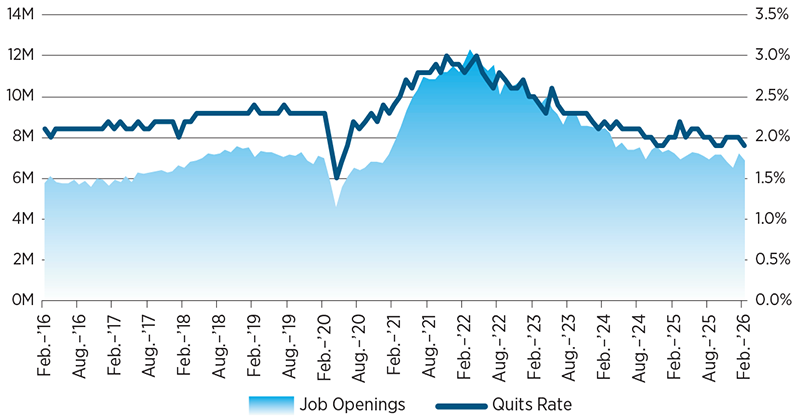
Source: Federal Reserve Bank of St. Louis.
Recent Economic Releases
| Indicator | Prior period | Current period (forecast) | Current period (actual) |
|---|---|---|---|
| Conference Board Consumer Sentiment (Mar.) | 91.0 | 88.0 | 91.8 |
| University of Michigan Consumer Sentiment (Mar.) | 56.6 | 54.0 | 53.3 |
| U.S. Job Openings (Feb.) | 7.24M | 6.9M | 6.88M |
| Quits Rate (Feb.) | 2.0% | N/A | 1.9% |