economy
March 16, 2026
Hormuz: Examining Hidden Risks to Rural America

A narrow stretch of water half a world away, the Strait of Hormuz may not appear all that connected to rural America. But if it were materially disrupted for a sustained period, the fallout could run deeper than headlines suggest. When Americans hear “Middle East conflict” they think oil prices. But the strait carries far more than crude, linking global flows of energy and essential materials that ripple through supply chains to rural America.
Take sulfur, a quiet but critical industrial input, for example. Sulfur is overwhelmingly produced as a by-product of oil refining and natural gas processing. It is then converted into sulfuric acid, the most widely used industrial chemical in the world.
Roughly three-quarters of sulfuric acid is used to manufacture phosphate fertilizers. If oil and gas flows through the Strait of Hormuz were curtailed for months, refining output would likely fall, tightening sulfur supply, which means constraints in phosphate fertilizer production.
The effects wouldn’t stop at fertilizers. Copper mining and processing rely heavily on sulfuric acid, particularly for oxide ores. Copper is essential to transformers, distribution lines, substations, irrigation equipment, grain handling systems and, increasingly, data centers and electrification projects. If sulfuric acid becomes constrained, copper production could tighten, pushing up prices and extending lead times for critical grid equipment.
There is also a consequential link through Taiwan. Roughly a quarter to a third of Taiwan’s liquefied natural gas (LNG) imports come from Qatar. Taiwan relies heavily on LNG for electricity, and a prolonged disruption could tighten power supplies or raise costs. Taiwan Semiconductor Manufacturing Company consumes roughly 9% of Taiwan’s electricity and produces about two-thirds of the world’s outsourced semiconductor manufacturing and 90% of the most advanced chips. If LNG shortages constrained Taiwan’s grid or raised power costs materially, chip output could be affected. That would ripple into delayed or more expensive servers, networking equipment and specialized components used in the rapidly growing data centers now moving into cooperative territories.
The Strait of Hormuz may feel distant. Yet its stability underpins not just oil prices, but agricultural inputs, electrical infrastructure materials, semiconductor supply chains and the broader industrial base rural America depends on. In an interconnected commodity system, an energy chokepoint can quickly become a fertilizer crisis, a transformer shortage, a chip bottleneck and a farm income squeeze all at once.
Strait of Hormuz Outbound Transits
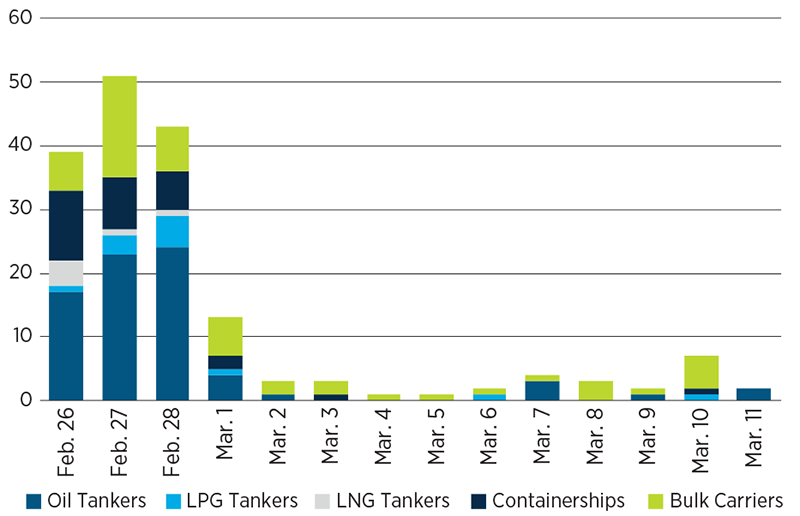
SOURCE: Automatic Identification System, Navigation Center by U.S. Coast Guards and Department of Homeland Security.