economy
May 4, 2026
Fertilizer Shock Hits US Farms After Oil Spike
The first wave of the Iran conflict was easy to see. Oil prices jumped, headlines followed and the focus once again settled on gasoline and global energy markets. That reflex is understandable. Oil is the most immediate transmission channel from geopolitical shock to everyday life. But two months on, a more consequential effect is emerging, one that is quieter, slower and unfolding far from ports and trading desks. It is showing up in the fields of rural America.
As outlined in my earlier piece on the Strait of Hormuz, energy flows underpin far more than fuel. They sit upstream of critical inputs like sulfur and ammonia that ultimately become fertilizer. When those flows are disrupted, the effects don’t stop at refineries—they cascade into agriculture. We are now seeing that cascade in real time. A nationwide survey conducted in April found that roughly 70% of U.S. farmers cannot afford all the fertilizer they need for the current planting season. This is more than a rising cost problem; it is a binding constraint. Fertilizer, particularly nitrogen, has surged alongside energy prices, while diesel costs have compounded the burden of application and transport.
Unlike fuel, fertilizer operates on a lag. Farmers make decisions months ahead, and April is not a moment for flexibility—it is planting season. Faced with higher costs, many are cutting application rates, shifting to less fertilizer-intensive crops or reducing acreage altogether. That shift matters because fertilizer is not optional at scale, it is foundational to modern yields. When farmers use less, reduced production follows. What began as an energy shock has become an agricultural problem and will become, eventually, a food supply issue.
The market has not fully priced this second-order effect. Oil spikes dominate the conversation because they are immediate. Fertilizer shortages draw less attention, but they may prove more durable. Lower yields will not show up at the pump. They will appear months from now, in tighter grain supplies and higher food prices.
The Strait of Hormuz still feels distant. But its disruption is no longer theoretical. It is already reshaping decisions on American farms and those decisions will echo through the economy long after oil volatility fades.
Percentage of Farmers Unable to Afford All Needed Fertilizer, by Region
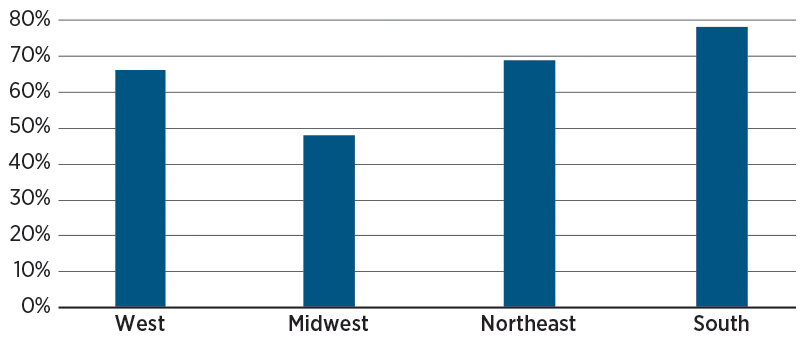
SOURCE: Fertilizer Availability Survey, American Farm Bureau Federation.