Electricity demand is growing rapidly, with a large share coming from artificial intelligence-driven data centers. By the end of the decade, 166 GW of new load is expected to come online, with data centers accounting for 55% of that demand. Because data centers need reliable, around-the-clock power, developers and hyperscalers are increasingly looking beyond traditional generation sources. That search is renewing interest in advanced nuclear technologies.
As demand for firm, carbon-free generation grows, investors are increasingly willing to back nuclear technologies. Since 2020, nuclear energy companies and startups have attracted significantly more funding. Venture capital (VC) and private equity investment in advanced nuclear energy companies increased from $1.8 million in 2020 to roughly $2 billion in 2025. In 2025, about 13 companies received early-stage through VC funding, more than double the number in 2024, with TerraPower and X-energy among the largest recipients. This spring, X-energy went public through an initial public offering that raised more than $1 billion.
Investments in Advanced Nuclear Energy Firms
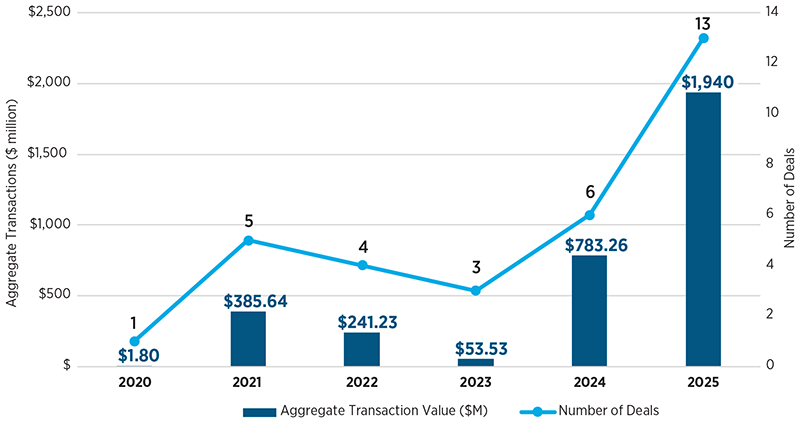
Sources: S&P Global Market Intelligence & Crunchbase.
This increased private investment has not emerged in isolation. Federal policy and financial support are helping reduce some of the risks that have historically challenged nuclear development. The U.S. Department of Energy (DOE) is supporting the sector on several fronts, including programs for next-generation advanced and small modular reactors, efforts to standardize fleet designs and support for expanding the fuel supply chain. In May 2026, DOE announced $94 million in project support for eight companies to deploy Generation III+ small modular reactors. In June 2026, DOE also announced $17.5 billion in conditional loan commitments to finance five projects that would deploy 10 large-scale advanced nuclear reactors with approved licenses.
Westinghouse’s AP1000 is the only licensed design in the U.S., and the project support could help reduce long lead times for manufacturing and delivering reactor components. Along with derisking projects, the federal government is exploring ways to update and streamline reactor licensing through the Nuclear Regulatory Commission to reduce time and costs for the industry.
While the future of nuclear energy and data center power appears increasingly intertwined, significant hurdles remain. Advanced nuclear projects face licensing, construction and commissioning timelines that can span years. First-of-a-kind reactor designs also carry higher costs until they reach commercial scale. Those timelines and costs may not align with the pace at which hyperscalers need new power supplies. Over the longer term, continued demand growth from data centers and other sectors will be critical to supporting broader deployment.
Electric cooperatives have a direct stake in how advanced nuclear technologies evolve, particularly as data center development expands into suburban and rural areas. Several cooperatives are already participating in advanced nuclear initiatives through the Tennessee Valley Authority. If these projects achieve the right balance of cost, safety and execution, they could reshape how reliable, carbon-free nuclear power is developed and deployed across the country.