energy-tech
March 16, 2026
Power Supply Trends To Watch in 2026: Renewables, Coal
Power supply dynamics are changing quickly in the U.S. Expiring federal tax incentives and new reliability-focused policies are prompting renewable energy developers to accelerate project timelines—at least in the near term—before growth becomes more constrained.
Context is important here. The Inflation Reduction Act (IRA) of 2022 used federal tax incentives to boost the development of renewable energy. In the years that followed, record volumes of renewable projects entered the grid interconnection queue. However, the passage of the One Big Beautiful Bill Act (OBBBA) in July 2025 triggered the phase-out of key IRA tax credits.
Under the new rules, wind and solar projects must be placed in service by December 31, 2027, to remain eligible for the production tax credit (PTC) and investment tax credit (ITC). Projects that fail to prove they began construction by July 4, 2026, or miss the 2027 in-service deadline, will lose access to these federal incentives. Energy storage, however, has an extended time horizon as new policies put a stronger emphasis on grid reliability. The ITC will remain available for grid-scale batteries through 2036.
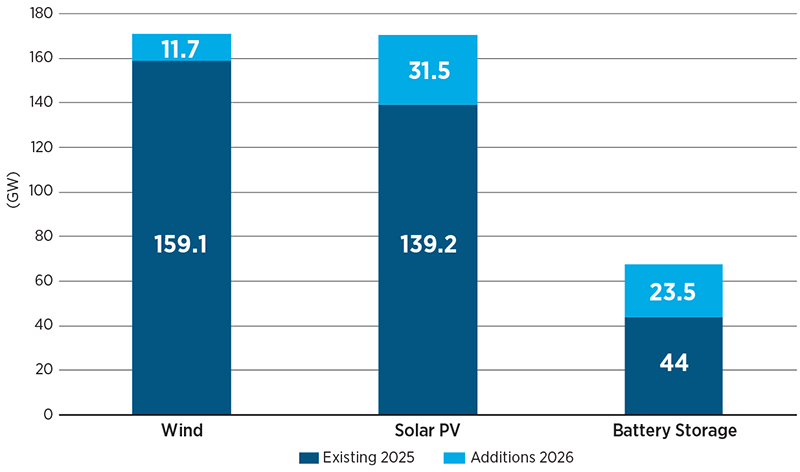
These OBBBA provisions are expected to accelerate solar deployment in the short term, making solar the fastest growing resource in 2026. According to the U.S. Energy Information Administration (EIA), the electric power sector is expected to add over 31 GW of new solar capacity in 2026, about 76% more than the year prior.
Similarly, battery storage and wind are also projected to see significant growth in 2026. The EIA forecasts more than 23 GW of new battery storage and nearly 12 GW of new wind capacity, up 38% and 65% from last year, respectively.
Electric Power Sector 2026 Generating Capacity Growth
SOURCE: EIA.
At the same time, federal policy is increasingly prioritizing dispatchable generation. In September 2025, Congress passed the Guaranteeing Reliability through the Interconnection of Dispatchable Power Act. The law directs the Federal Energy Regulatory Commission to improve interconnection timelines with an emphasis on dispatchable resources when a clear reliability need is demonstrated.
Even so, faster permitting and interconnection processes still face real-world constraints, especially on the equipment side. According to the Penn State Institute of Energy and the Environment, more advanced gas turbines are effectively sold out years in advance, with manufacturing slots booked out for the next several years. A key bottleneck is the limited number of foundries that can produce the critical high‑temperature components of a gas turbine.
As a result, even with a federal push toward dispatchable generation, natural gas additions in 2026 are expected to remain modest compared to renewables. In the near term, most new firm capacity additions are expected to come from battery storage.
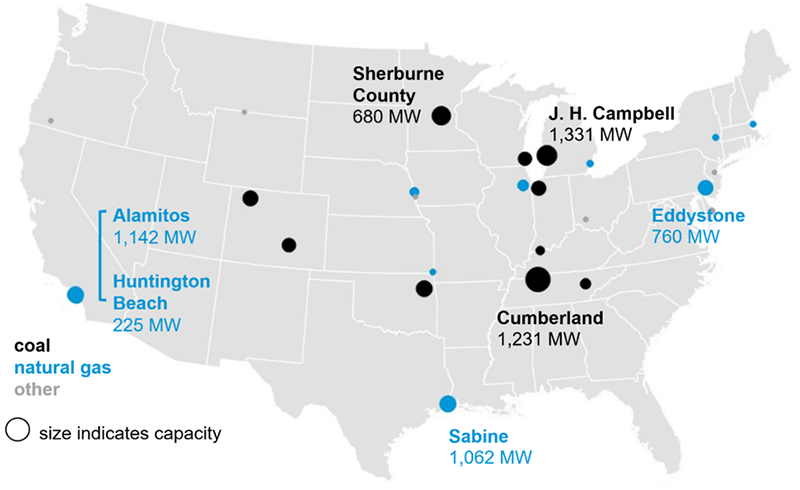
Meanwhile, power demand is expected to grow rapidly over the next several years, keeping reliability concerns front and center. The U.S. Department of Energy (DOE) has been increasingly active in delaying coal plant retirements to preserve dispatchable capacity. According to the EIA, coal plant owners planned to retire 8 GW of capacity last year, but several DOE emergency orders reduced actual retirements to 2.6 GW. These emergency orders require coal plant owners to continue operating through a specified date.
Looking to this year, EIA expects 6.4 GW of coal capacity to retire—about 4% of the existing U.S. coal fleet—along with 4.6 GW of natural gas retirements. Nearly 80% of the natural gas capacity seeking retirement consists of older steam turbines, which are generally far less efficient than newer combined-cycle assets.
The EIA estimates that natural gas capacity will still grow by 1.2 GW in 2026, exceeding scheduled retirements. And given current reliability concerns, it is likely DOE will continue using emergency authorities, which could keep additional dispatchable capacity online beyond what current retirement schedules indicate.
Bottom line: 2026 is shaping up to be a year of near-term renewable acceleration—particularly for solar and storage—alongside renewed policy emphasis on dispatchable resources. But supply chain constraints and rising reliability risks are making it harder to add firm capacity quickly, increasing the odds that coal plants (and other existing dispatchable assets) remain online longer than many plans originally assumed.
Planned US Utility-Scale Electric Capacity Retirements in 2026
SOURCE: EIA.