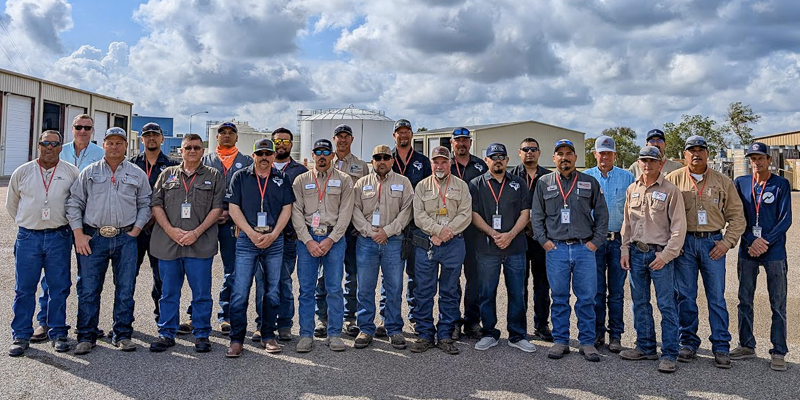
Last November, a team of volunteer line workers from South Texas Group 7 electric cooperatives traveled to Guatemala to bring electricity to homes and businesses in two rural villages for the first time. CFC and Utility Capital Solutions supported the mission with $70,000 in grants.
The project marked the second international electrification effort for the South Texas Group 7 cooperatives, following their 2023 mission to the village of Matasanos (see South Texas Co-ops Bring Light to Guatemalan Village, CFC Solutions Cooperative News, October 14, 2024).
“We requested a project for 2025 the day before returning to the U.S. after the Matasanos project was completed,” said Jim Coleman, general manager of Jackson Electric Cooperative and Group 7 chairman. “Anyone who participates in one of these international projects comes home with a feeling of immense satisfaction from improving the lives of people receiving electricity for the first time. Access to electricity truly enhances quality of life, education and economic opportunity for local villagers.”
Coleman and Avan Irani, general manager of Nueces Electric Cooperative, joined line workers and electricians from nine South Texas Group 7 distribution cooperatives and generation and transmission cooperative South Texas Electric Cooperative. The team spent nearly three weeks connecting homes and community buildings in the remote villages of Yalicar and Palos Grande Los Cocales to the electric grid.
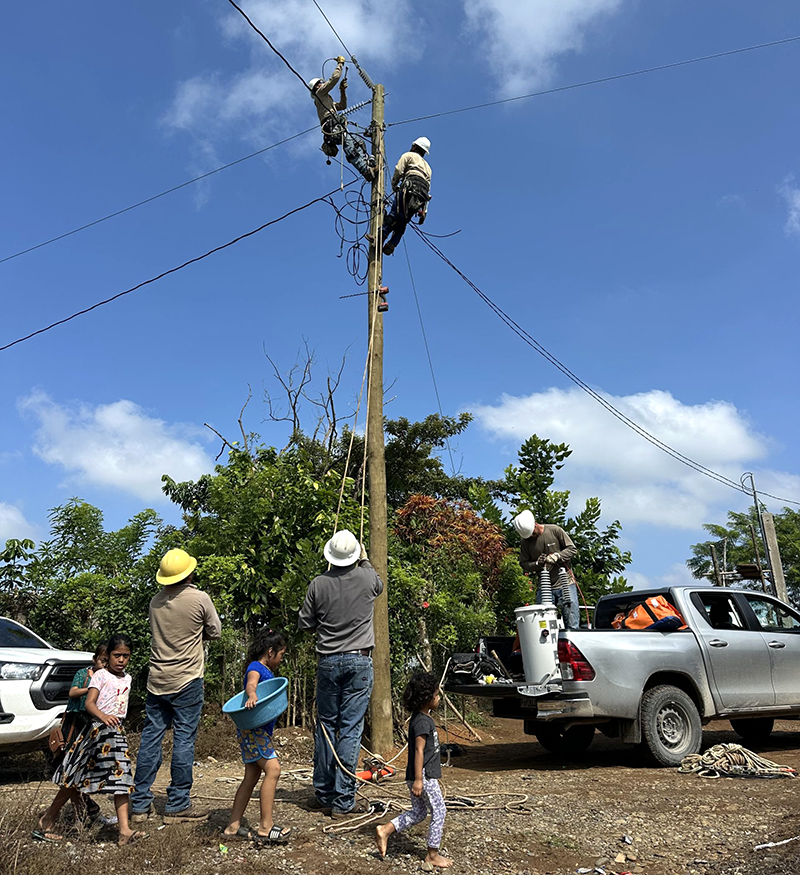 Line workers atop a pole connecting line.
A Two-Day Trek
Located in Guatemala’s remote Ixcan region near the Mexican border, Yalicar is difficult to reach.
“It takes the better part of two days to get there from Texas,” Coleman said. “Between our hotel and the village, there was an 8-mile stretch of unimproved road consisting of dirt, mud, rocks and large potholes that took us an hour to cross, twice each day.”
The crew also faced the challenge of working without the equipment they typically rely on.
“Working without modern equipment is a pretty big deal. Poles had to be dug and set by hand and, without bucket trucks, every pole had to be climbed the old-fashioned way,” Coleman said.
The Texas crew began by connecting to a line recently built by electric cooperative volunteers from Arkansas.
“The Yalicar project plan was to build 3.5 kilometers of primary line, 3 kilometers of secondary line, set 56 poles and install six transformers to serve 117 homes. All locations had to be wired and meter loops built,” Coleman said. “The crews worked so well as a team that they finished a week early.”
Finishing ahead of schedule allowed the team to expand the project. The crew built an additional kilometer each of primary and secondary line, set 17 more poles with assistance from the local municipal utility, Empresa Municipal Rural de Electricidad, and installed additional transformers.
“We hooked up every location in the Yalicar project and more,” Coleman said. “During the extra days, crews extended the line into part of the next village and continued building, wiring and energizing homes, businesses, churches and schools until we ran out of material.”
By the end of the project, the team had connected 135 homes and buildings, wired and energized the school, installed eight ceiling fans and added 12 streetlights, all with a day to spare.
Electricity Changes Lives
Access to electricity transforms everyday life. Many homes in the villages are simple structures with dirt floors. Residents cooked over open fires and relied on candles for light after dark. Electricity changes that reality.
“There are so many examples of how electricity changes the lives of these villagers,” Coleman said. “Even before the lines were energized, I saw new signs and small buildings being built for a barber shop and an ice cream and snack shop.”
But bringing electricity to remote communities is expensive.
“The funds provided by CFC and Utility Capital Solutions made a huge impact on the project,” Coleman said. “We estimate each project costs about $280,000, so every donation helps.”
“The international electrification program makes an enormous difference in the world,” Coleman added. “Just remembering the feeling of bringing electricity to people who have never had it always brings a tear to my eye. I would encourage all electric cooperatives to volunteer or make a substantial donation. We have everything and they have nothing.”
The South Texas Group 7 cooperatives are already scheduled to participate in another international electrification project in 2028.