economy
July 13, 2026
Eyes on the Economy: Manufacturing, Confidence, Jobs

Manufacturing Growth Cools in June
The Institute for Supply Management Manufacturing Purchasing Managers’ Index slipped to 53.3 in June 2026 from 54.0 in May, although still above 50—the benchmark indicating expansion. The index fell slightly short of market expectations and signaled a modest slowdown in manufacturing activity. While the sector continued to expand, growth in both output and new orders moderated from the previous month. Employment remained in contraction, although labor market conditions improved slightly, with the employment subindex rising to 49.7 from 48.6, indicating a slower pace of job losses. Meanwhile, the prices subindex fell sharply to 73.0 from 82.1, suggesting that input cost pressures eased, though inflation remained elevated. Manufacturers continued to cite concerns over persistent inflation, partly linked to geopolitical tensions in the Middle East, as well as the potential for higher interest rates. Ongoing uncertainty surrounding tariffs and global trade policy also remained a significant headwind for the sector's outlook.
Consumer Confidence Edges Higher as Inflation Fears Ease
The Conference Board Consumer Confidence Index edged up 0.6 points to 91.2 in June, recovering slightly from May’s revised reading of 90.6 as lower oil prices helped ease inflation concerns. The subindex for present situation fell 3.0 points to 116.4, reflecting weaker assessments of current labor market conditions, while the subindex for expectations rose 3.0 points to 74.4 on improved outlooks for business conditions and household income. Consumers viewed current business conditions somewhat more favorably, but confidence in the job market weakened, with 22.5% saying jobs were "hard to get," the highest share since January 2022. However, expectations for labor market conditions six months ahead remained largely unchanged. Meanwhile, assessments of current family’s finances deteriorated for a third consecutive month, although expectations for future finances improved. Consumers also became somewhat more likely to expect a recession over the next year, though overall recession concerns remained relatively subdued.
June Jobs Miss Expectations as Hiring Slows and Labor Force Shrinks
The U.S. economy added 57,000 jobs in June 2026, well below expectations of 110,000 and down from a downwardly revised 129,000 in May. While this marked the weakest monthly gain in four months, it remained broadly consistent with the modest average pace of job growth over the past year. Hiring was concentrated in professional and business services, social assistance and healthcare. In contrast, leisure and hospitality lost 61,000 jobs, reflecting weaker than normal seasonal hiring. Most other major industries, including construction, manufacturing, retail, transportation, financial activities and government, showed little change. Payroll estimates for April and May were also revised lower by a combined 74,000 jobs.
Despite slower hiring, the unemployment rate fell from 4.3% to 4.2% largely because fewer people participated in the labor force rather than stronger employment. Total employment declined by 507,000, while the labor force shrank by 720,000 to 162.26 million, pushing the labor force participation rate down to 61.5%, its lowest level since March 2021. Meanwhile, wage growth was 3.5%, a slight increase from 3.4% in the previous month. Although wage growth has been on a decline trend, it is still running slightly above pre-COVID levels.
Labor Force Participation Shrinks
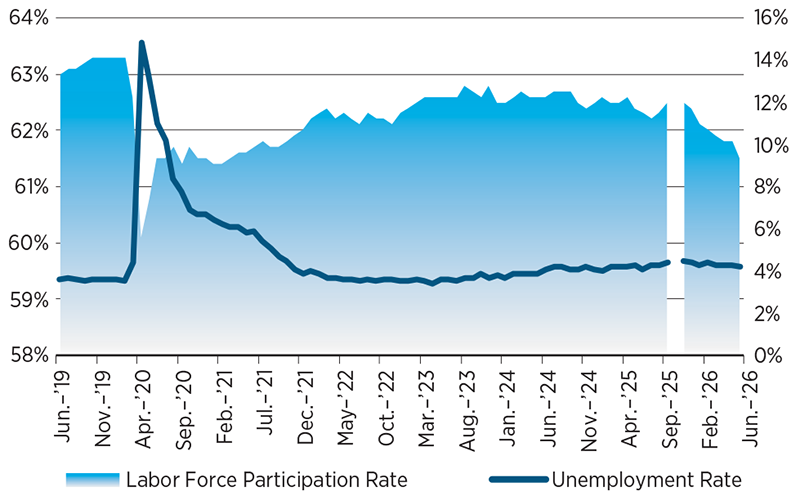
SOURCE: U.S. Bureau of Labor Statistics.
Recent Economic Releases
| Indicator | Prior period | Current period (forecast) | Current period (actual) |
|---|---|---|---|
| ISM Manufacturing PMI (Jun.) | 54.0 | 55.7 | 53.3 |
| Conference Board Consumer Confidence (Jun.) | 90.6 | 94.7 | 91.2 |
| Nonfarm Payrolls (Jun.) | 129K | 110K | 57K |
| Unemployment Rate (Jun.) | 4.3% | 4.3% | 4.2% |
Key Interest Rates
| 7/6/26 | 6/29/26 | Change | |
|---|---|---|---|
| Fed Funds | 3.75% | 3.75% | --- |
| 2-yr. UST | 4.13% | 4.11% | 0.02 |
| 5-yr. UST | 4.21% | 4.14% | 0.07 |
| 10-yr. UST | 4.53% | 4.38% | 0.15 |
| 30-yr. UST | 4.99% | 4.86% | 0.13 |
Rate Forecast — Futures Market
| 3Q26 | 4Q26 | 1Q27 | 2Q27 | |
|---|---|---|---|---|
| 4.00% | 4.00% | 4.25% | 4.25% | |
| 3.98% | 3.89% | 3.80% | 3.74% | |
| 4.08% | 4.02% | 3.97% | 3.94% | |
| 4.44% | 4.39% | 4.35% | 4.33% | |
| 4.94% | 4.90% | 4.87% | 4.86% |