- Main
-
Last week, I was sitting in an industrials forum in Manhattan, listening to executives discuss the infrastructure behind America’s artificial intelligence (AI) boom. As an economist who has spent the past two years covering artificial intelligence, data centers and the capital spending frenzy surrounding them, I expected to hear familiar concerns: GPUs, power generation, cooling systems and perhaps labor shortages. Instead, I heard something that caught me off guard.
The conversation turned to fiber optics. Not broadband internet service. Not consumer connectivity. But optical connectivity stack. Several speakers described a market under strain, with lead times extending, multi-year commitments and hyperscalers racing to secure supplies. The implication was startling: One of the next major bottlenecks to AI deployment may not be chips at all, but the fiber that connects them.
The shortage has received remarkably little mainstream attention. By now, the AI chip shortage is widely understood. NVIDIA’s GPUs have become a household name. Investors follow every development in advanced semiconductor packaging and high-bandwidth memory. Stories about chip bottlenecks regularly appear in major newspapers and business channels. Fiber, by contrast, remains largely invisible.
Yet modern AI infrastructure consumes extraordinary amounts of optical connectivity. Massive clusters of GPUs must communicate continuously with one another. The result is a surge in demand not only for semiconductors, but also for optical fiber, transceivers and the manufacturing inputs that make them possible. Industry reports suggest that advanced AI deployments require dramatically more fiber than traditional data centers, creating pressure throughout the supply chain.
From an economic perspective, this development is a useful reminder that bottlenecks rarely stay in one place. The early stages of the AI boom were constrained by compute. As chip production expanded, the constraint shifted toward advanced packaging and memory. Now, attention is increasingly turning toward power generation, transmission infrastructure and optical networking. Supply constraints move through the economy like water finding the narrowest point in a pipe.
The broader lesson is that AI has evolved beyond algorithms and applications. It is increasingly a story of physical infrastructure, supply chains and industrial capacity. The next phase of competition may not be determined solely by who can build the best models, but by who can secure the physical infrastructure needed to run them. If that proves true, fiber optics may soon become as economically important and widely discussed as semiconductors are today.
economy
June 1, 2026
Uncovering the Latest Constraint in the AI Economy

Hyperscaler Transceiver Demand Projection for Pluggable, by Bandwidth
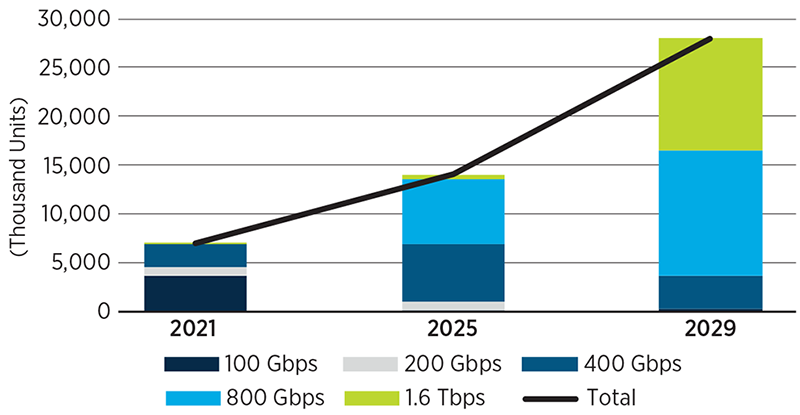
Source: McKinsey & Company.