- Main
-
There is something about a breezy evening in San Diego after a long day at a conference that invites big conversations where someone remarks that we still have no idea what artificial intelligence (AI) will ultimately be capable of. From there comes the familiar conclusion: if AI continues advancing, most jobs will eventually disappear. The premise is correct, but the conclusion is not.
History teaches us that we are good at advancing transformative technologies but not at predicting how society emerges around them. The ATM did not eliminate bank employees. The internet transformed nearly every industry but did not end work. Even our expectations for the cellphone missed the mark. We imagined phones becoming smaller, not evolving into pocket-sized computers where larger screens became more valuable. Time and again, our predictions about the social consequences of transformative technologies fell short.
AI’s future capabilities are a matter of technology. Whether the capabilities will lead most people to become unnecessary workers is a matter of economics and human nature. After all, economics grew out of philosophy, and its central insight remains unchanged: Life is defined by scarcity. We have finite time, attention and resources. Every decision carries an opportunity cost because choosing one thing means giving up another. AI may make us dramatically more productive, but it cannot create a 25th hour in the day or remove the need to choose among competing ends. Nor can it eliminate the boundlessness of human aspiration.
If AI becomes an extraordinary diagnostician, we won’t need fewer doctors; we will demand more of them: more personalized care, better preventive medicine and higher standards than today's healthcare system can provide. Technology rarely satisfies our desires, it raises them. Every major advance in productivity has been followed not by the exhaustion of human wants, but by the creation of new ones and higher expectations of ourselves, one another and society. As long as time remains finite, attention remains scarce and human aspirations continue to grow, as there will always be new problems to solve, new standards to pursue and new forms of work to do. AI may transform the nature of work, but it cannot eliminate the human condition that gives rise to work in the first place.
economy
July 13, 2026
Why AI Will Transform Work, Not Eliminate It

Technology-Driven Productivity Has Not Led to Lower Employment
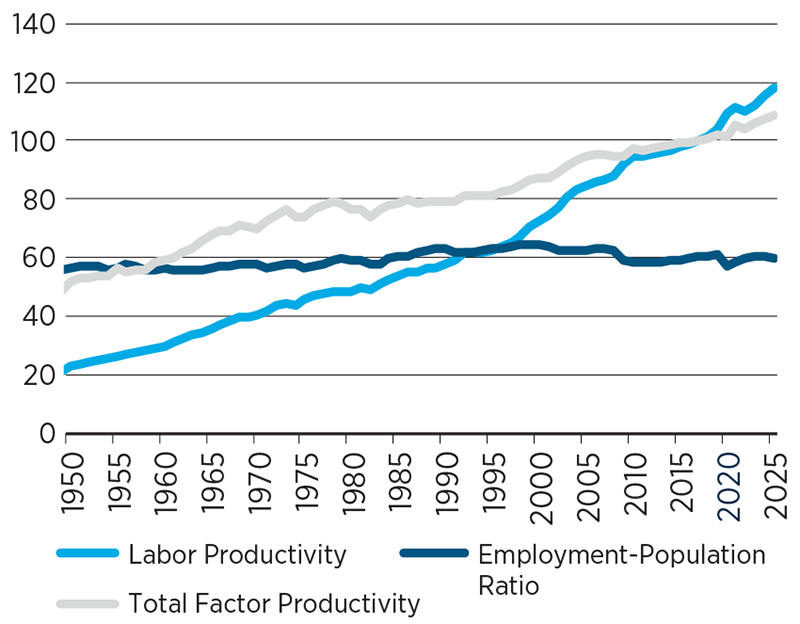
SOURCE: U.S. Bureau of Labor Statistics.