The first major heat wave of the summer has provided an early stress test for the U.S. power grid. During the week of the nation’s 250th Independence Day celebration, dangerous, record-breaking temperatures swept across much of the central and eastern U.S., prompting grid operators to prepare for unusually high demand. PJM projected that load could surpass its 2006 summer peak record, while the Department of Energy authorized emergency measures to maximize generation output and, if necessary, permit curtailment of certain large loads with backup generation. Other grid operators, including MISO, NYISO and ISO New England, also warned of tight conditions or called for conservation as heat indexes climbed as high as 115 degrees.
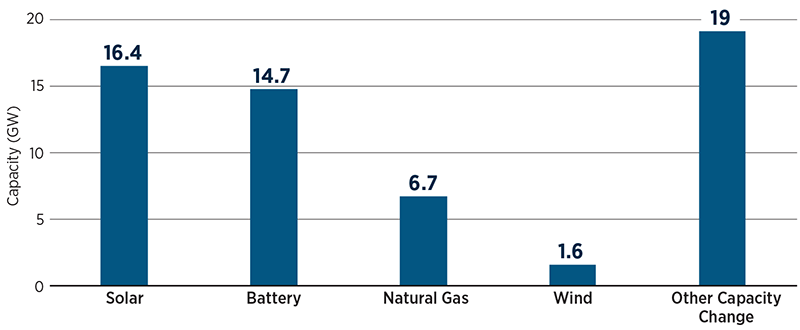
That real-world test reinforces the central finding of the North American Electric Reliability Corp.’s (NERC) 2026 Summer Reliability Assessment: The grid is better positioned than it was a year ago, but extreme weather can still expose vulnerabilities. NERC said all assessment areas should have adequate resources to meet normal summer peak demand. Record resource additions have strengthened reserves across much of North America. Since last summer, 58.5 GW of new resources—solar, battery storage and natural gas generation—have been added, bolstering available capacity. In 2025, the Department of Energy also issued emergency orders requiring certain coal and fossil fuel generators to remain operationally available, providing additional firm capacity to the grid.
Resoure Capacity Additions Since 2025
SOURCE: NERC.
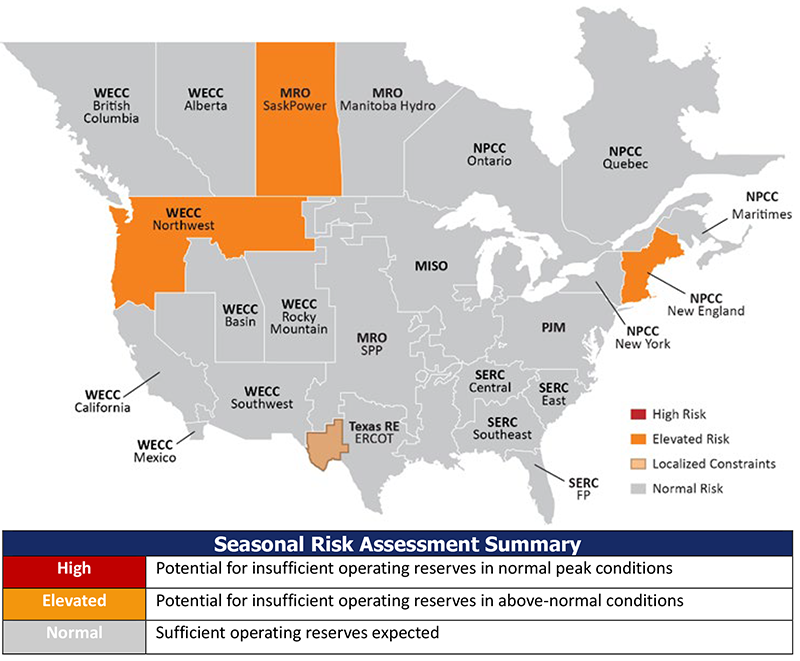
NERC identified several regions where reliability risks remain elevated under above-normal or extreme conditions. New England faces tighter reserve margins and rising electricity demand driven by electrification. NERC also highlighted localized challenges in far western ERCOT, where rapid load growth, low wind or solar output and transmission constraints could limit deliverability. In the Northwest, drought, low snowpack and reduced hydropower availability have created a new area of elevated risk. NERC said El Niño weather patterns could contribute to drier conditions in the Northwest while bringing wetter conditions to the Gulf Coast.
The assessment also reflects a meaningful shift from last year. In its 2025 assessment, NERC warned of broader summer supply shortfall risks across multiple regions because of rapid load growth, generator retirements, low renewable output and declining reserves. This year, the number of at-risk areas has declined largely because additions of solar, battery storage and natural gas generation have outpaced load growth. However, the remaining risks are more operationally complex and location specific.
NERC’s Summer Reliability Risk Area Summary, 2026
SOURCE: NERC.
For electric cooperatives, the key takeaway is that improved resource adequacy does not eliminate the need for preparedness. Cooperatives should review summer operating plans, outage coordination procedures, demand response programs, member communication strategies and exposure to wholesale market or hydropower risks. Summer reliability in 2026 will depend not only on having sufficient capacity, but also on whether resources, transmission systems and flexible load can perform when extreme heat, weather conditions and local constraints converge.