
In May, NextEra Energy announced a $67 billion all-stock acquisition of Dominion Energy, arguably the most significant utility transaction in recent years. If completed, the deal would create one of the nation’s largest electric utilities, with a combined portfolio of 110 GW that is expected to grow to 260 GW by 2032.
The strategic rationale is scale. A larger platform allows NextEra to capture economies of scale in building and financing infrastructure while expanding its presence in high-growth regions. The acquisition will provide access to Virginia’s “data center alley,” where rising demand from hyperscale customers is reshaping load growth. By combining its strengths in renewable energy and battery storage with Dominion’s distribution and interconnection infrastructure, the company is positioning itself to address accelerating demand and reliability challenges in PJM.
NextEra and Dominion’s Power Plants in the US
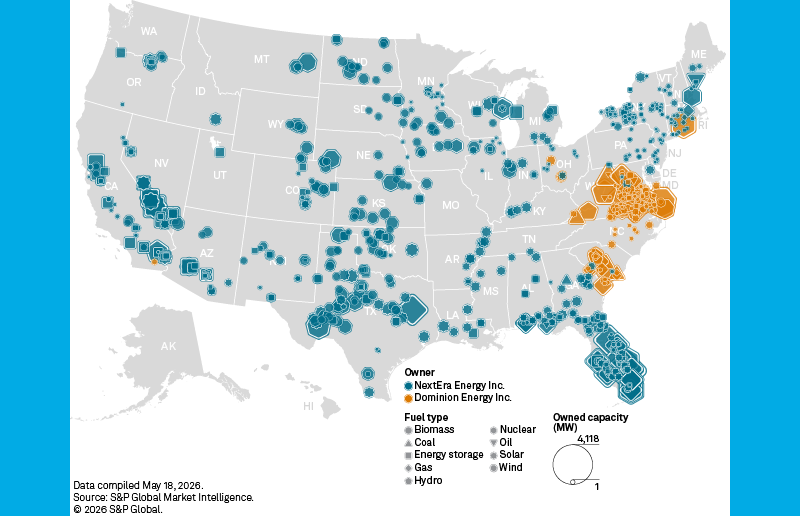
SOURCE: S&P Global Market Intelligence.
The merger comes at a pivotal moment for the power sector. Electricity demand is rising rapidly, driven by data centers, advanced manufacturing and electrification of heating. At the same time, utilities face mounting pressure to modernize aging infrastructure. The generation mix is also shifting, with natural gas and renewables playing an increasingly larger role as coal units retire.
Against this backdrop, the NextEra-Dominion deal reflects a broader trend among investor-owned utilities (IOUs): pursuing scale to access capital and fund large, long-term investments. According to the Edison Electric Institute, IOUs are expected to make approximately $1.4 trillion in capital expenditures between 2026 and 2030.
Largest Utility Deals in the US Since 2016
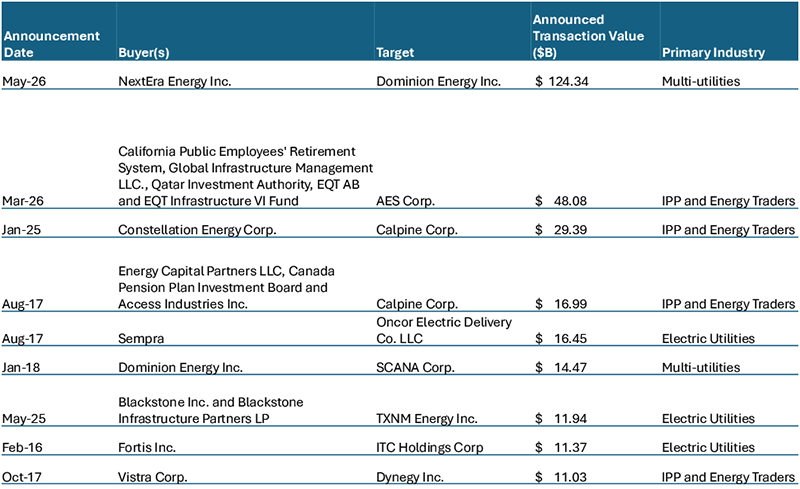
Data compiled May 19, 2026. Includes whole company acquisitions in the US utilities sector, announced between Jan. 1, 2016, and May 18, 2026, where the transaction value at announcement was at least $10 billion. Excludes terminated deals and water-utilities deals. Transaction value includes the deal value paid for equity, plus the value of assumed current liabilities, net of current assets. Source: S&P Global Market Intelligence. © 2026 S&P Global.
Electric cooperatives face similar pressures from rising demand and the need to modernize, upgrade and build new grid infrastructure. While large-scale data center load growth is less pronounced in rural areas today, demand is expected to expand as urban and suburban markets reach capacity. To meet the needs of an evolving grid, cooperatives are increasing capital expenditures in an environment of higher interest rates, tariffs and supply chain constraints. As a result, cooperatives must balance industry pressures with tighter financial conditions.
These economic challenges are prompting cooperatives to explore new approaches to financing and growth. In addition to traditional funding sources, cooperatives are using a broader set of financial tools, including private placements and loan syndications. Some are also exploring hybrid ownership models for generation and transmission projects to reduce risk and attract additional capital.
Recent partnerships illustrate this shift:
- In May 2025, Dairyland Power Cooperative and GridLiance, a subsidiary of NextEra Energy Transmission, agreed to jointly develop and co-own the MariBell Transmission Project, a 139-mile double-circuit line in Minnesota and Wisconsin.
- In April 2026, PNGC Power and Kindle Energy announced a partnership to develop a natural-gas power plant in northern Idaho by 2032, with PNGC structuring the project through a toll agreement with Kindle Energy.
While IOUs pursue scale through consolidation, cooperatives can achieve similar outcomes through strategic investment, innovative financing and partnership-driven growth. This approach positions cooperatives to meet rising demand while continuing to prioritize affordability, reliability and community needs.