economy
August 24, 2026
Eyes on the Economy: Sentiment, Industrial Production, Inflation

Consumer Sentiment Falls as Inflation Worries Persist
Consumer sentiment fell about 8% in August, reversing two months of improvement. While assessments of personal finances declined only modestly, expectations for business conditions deteriorated sharply, falling 11% for the year ahead and 17% over the longer term. Sentiment weakened across political affiliations and demographic groups, with particularly large declines among older, lower-income and non-college-educated consumers, groups that are especially exposed to inflation’s impact on purchasing power. Only 8% of consumers now expect income growth to outpace inflation over the next year, down from 18% in December 2024, underscoring continued concern about high prices.
Inflation expectations also remain elevated. Year-ahead inflation expectations edged up to 4.3% from 4.2% in July, well above the 3.4% recorded in February and all 2024 readings. Long-run inflation expectations remained unchanged at 3.3% for a third consecutive month, slightly above the 2.8%–3.2% range observed in 2024.
Industrial Production Posts Modest Gains as Manufacturing Advances
Industrial production rose 0.2% month over month in July, following a 0.3% increase in June, with manufacturing output also gaining 0.2%. Mining and utilities production increased 0.2% and 0.5%, respectively. Overall industrial production stood 1.1% above its year-earlier level. Manufacturing excluding motor vehicles was stronger, rising 0.4%, while motor vehicle and parts production fell 2.1%.
Performance across major market groups was mixed. Consumer goods production declined 0.4%, including a 1.4% drop in durable consumer goods. In contrast, business equipment output rose 0.8%, defense and space equipment increased 1.8% and construction supplies gained 0.8%. Within manufacturing, durable goods production advanced 0.7%, with broad gains across most categories, while nondurable goods output fell 0.4%.
Capacity utilization edged up to 76.3% but remained 3.1 percentage points below its long-run average, indicating that industrial capacity continues to have meaningful slack despite modest production growth.
US Inflation Moderates Slightly as Energy Pressures Ease
Inflation moderated in July 2026, with the annual Consumer Price Index (CPI) rate easing for a second consecutive month to 3.4% from 3.5% in June, in line with expectations. Inflation has moved further below its May 2026 level of 4.2% as the effects of the energy shock associated with the Iran war have eased. Gasoline prices remained sharply higher than a year ago but slowed to a 24.6% increase, while fuel oil inflation eased to 39.1%. Shelter inflation edged down to 3.2%. Food inflation held steady at 3.0%. On a monthly basis, CPI increased 0.1% after declining 0.4% in June. Shelter rose 0.1% and accounted for roughly two-thirds of the overall monthly increase, while food prices also gained 0.1%. Gasoline prices, meanwhile, declined 2.9%. Excluding food and energy, core CPI rose 0.2% for the month, while the annual core rate declined to 2.5% from 2.6%.
Wholesale inflation also eased, with headline Producer Price Index (PPI) inflation slowing to 4.7% year over year from 5.5% in June. Monthly PPI was unchanged, while core wholesale prices rose 0.2% and remained 4.2% above year-ago levels.
Wholesale Inflation Moderates but Remains Elevated
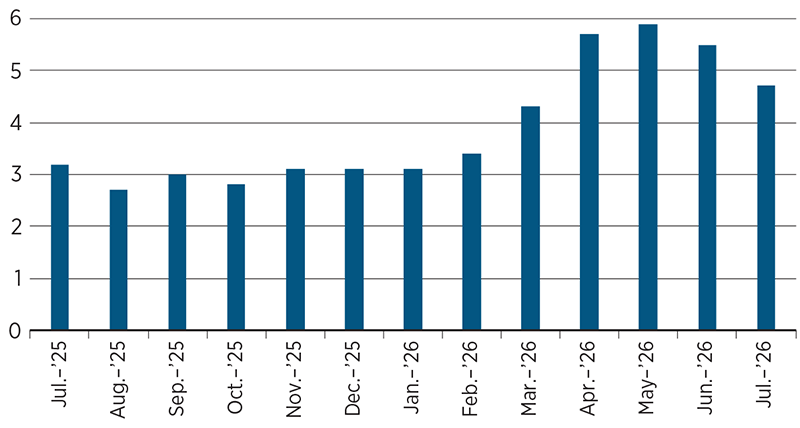
Source: Trading Economics.
Recent Economic Releases
| Indicator | Prior period | Current period (forecast) | Current period (actual) |
|---|---|---|---|
| University of Michigan Consumer Sentiment Index (Aug.) | 55.2 | 54.5 | 51.0 |
| Industrial Production (Jul.)(MoM) | 0.3% | 0.3% | 0.2% |
| Consumer Price Index (Jul.)(YoY) | 3.5% | 3.4% | 3.4% |
| Producer Price Index (Jul.)(YoY) | 5.5% | 4.9% | 4.7% |
Key Interest Rates
| 8/17/26 | 8/10/26 | Change | |
|---|---|---|---|
| Fed Funds | 3.75% | 3.75% | --- |
| 2-yr. UST | 4.18% | 4.24% | (0.06) |
| 5-yr. UST | 4.38% | 4.41% | (0.03) |
| 10-yr. UST | 4.72% | 4.70% | 0.02 |
| 30-yr. UST | 5.31% | 5.24% | 0.07 |
Rate Forecast — Futures Market
| 3Q26 | 4Q26 | 1Q27 | 2Q27 | |
|---|---|---|---|---|
| 3.75% | 4.00% | 4.00% | 4.00% | |
| 4.08% | 3.97% | 3.89% | 3.82% | |
| 4.17% | 4.09% | 4.00% | 3.96% | |
| 4.48% | 4.42% | 4.35% | 4.33% | |
| 4.96% | 4.91% | 4.87% | 4.86% |