- Main
-
Imagine turning 18 and receiving a notification: Your free trial has ended; to continue, subscribe to life. Welcome to a world where almost everything comes with a recurring charge. The software you once bought now bills you every month. Your television, music, cloud storage and artificial intelligence (AI) assistant all require subscriptions. Even the home you own may come with monthly homeowner association (HOA) dues that never disappear.
For generations, homeownership represented the ultimate escape from recurring housing payments. The goal was straightforward—pay off the mortgage and enjoy the financial security that came with owning your home. Property taxes and maintenance were accepted as part of the bargain, but the largest monthly payment eventually disappeared.
That equation is changing. For millions of Americans, a paid-off mortgage no longer means housing-related financial obligations become minimal. Monthly HOA dues are permanent and rising rapidly in many communities. According to a recent Wall Street Journal report, HOAs facing higher insurance premiums, labor costs, maintenance expenses and reserve funding requirements are pursuing foreclosures against delinquent homeowners at an increasing rate. In some cases, missing HOA payments, not mortgage payments, has become the greatest threat to keeping a home.
There are many good reasons for the existence of HOAs. New developments often require private community infrastructure to make the economics possible. As we expanded the real estate footprint in recent years, the share of newly constructed homes with HOAs increased from 49% in 2011 to 67% in 2024. This represents a significant shift that’s further amplified by rising HOA operational costs, leading to more homeowners paying higher fees indefinitely. Furthermore, rising home values translate directly to higher property taxes. All these factors combined mean that staying at a property that they already bought requires homeowners to make payments that are not only recurring but also subject to increases.
It’s becoming a trend that buying an asset no longer means escaping recurring payments. Instead, ownership often comes bundled with obligations that continue indefinitely. Housing may be the clearest example, but it is hardly the only one. Underneath modern ownership often lie subscription-like payments that never truly end.
economy
August 11, 2026
Recurring Costs Are Reshaping Ownership
Share of New Construction Homes with HOAs
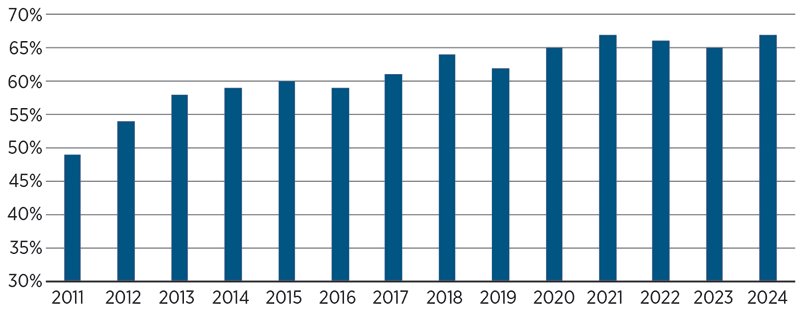
SOURCE: U.S. Census Bureau.