- Main
-
The U.S. national debt has crossed $40 trillion for the first time. Round numbers can be arbitrary, but this one deserves attention—not because $40 trillion represents some magical threshold, but because of how quickly we got here. The national debt stood at $30 trillion in January 2022. An increase of roughly one-third in less than five years is not a sustainable trajectory.
There is plenty of blame to go around. Revenue has not kept up with expenditures. Wars, the pandemic response and other spending programs have added trillions to deficits. Meanwhile, an aging population is increasing the cost of Social Security and healthcare. Neither political party has demonstrated much appetite for the unpleasant combination of spending restraint and additional revenue that would materially change the equation.
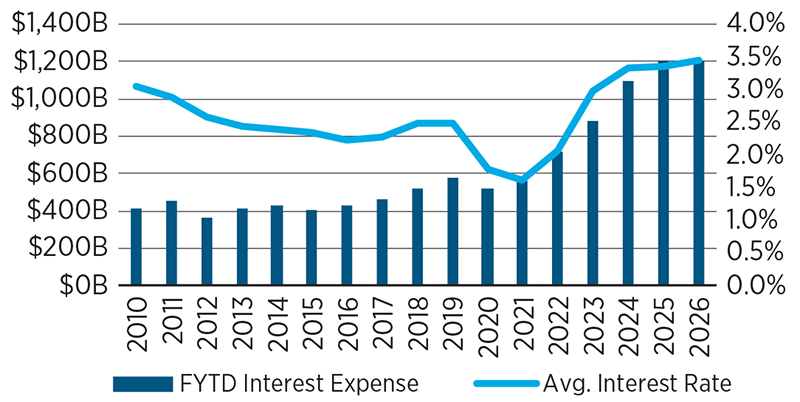
Now another force is accelerating the problem—the cost of the debt itself. With two months remaining in fiscal year 2026, federal interest expenses have already reached $1.17 trillion, 15% higher than a year earlier. Interest is now the government’s third-largest spending category, behind healthcare and Social Security.
Recent Treasury auctions illustrate the problem. The latest 30-year bond auction resulted in the government’s highest financing cost at that maturity in a quarter century. The preceding 10-year auction produced the highest financing cost for that maturity since 2007. That creates an increasingly dangerous feedback loop. Large deficits require more borrowing. More Treasury supply must find buyers. Investors may demand higher yields to absorb it. Those higher yields increase government interest expense, widening deficits and requiring even more borrowing. This matters even if the Federal Reserve cuts short-term interest rates. The Fed controls overnight rates; it does not dictate what investors will demand to lend the government money for 10 or 30 years.
Treasury Secretary Scott Bessent has targeted a deficit of around 3% of gross domestic product (GDP) by 2029, yet it was roughly 6% of GDP in July. Economists, Wall Street and the Congressional Budget Office see little meaningful improvement ahead. The uncomfortable possibility is that fiscal discipline will arrive only when financial markets demand it. Markets, not Congress, may ultimately decide when America has borrowed enough. But the even more uncomfortable possibility is that when markets decide enough is enough, it may come in the form of a crisis.
economy
August 25, 2026
Why the $40 Trillion Debt Milestone Matters

US Interest Expense Rises as Interest Rates Elevate
SOURCE: U.S. Department of Treasury.